Call Dave: 936-662-5100
Composite Dock Decking · Texas

Composite dock decking gets hot. Start there.

It is the first thing Texans ask and the last thing a brochure answers. So: the heat, then the spans, the products rated over water, the fasteners and the gaps. Our decks and boardwalks page makes the short case; this is the long one.

The Question Everyone Asks First

It runs hotter than wood. That is physics, not a defect.

A page that hides its material's weak point loses the argument on the first July afternoon.

Composite and capped composite boards are commonly reported at 140°F and above in direct sun, dark colours past 170°F. Cedar and redwood in comparable conditions sit nearer 90 to 105°F. Two properties drive it: dark plastic absorbs more of the sunlight landing on it, and the plastic matrix moves that heat into whatever touches it faster. Composite holds more heat and delivers it quicker — which is why a timber deck can read close to a composite one on a thermometer and still feel cooler underfoot.

Treat every figure above as directional, ours included. Every heat comparison we could find is run by somebody selling one of the materials — the most-cited field test belongs to a company that sells tropical hardwood, and a well-known "temperature test" page is a video transcript with no measurements and no instrument named. Which is why we will not repeat the cooling percentages circulating for the board named on our own drawings: go to the manufacturer's page and they are not there.

Colour beats brand. One comparison within a single brand spanned roughly 93 to 101°F under identical conditions — same board, same day, different pigment. And these are surface temperatures, not air. Which makes it a specification question rather than a comfort one, since ASTM C1055 puts the practical hot-surface contact limit near 140°F for about five seconds of skin contact.

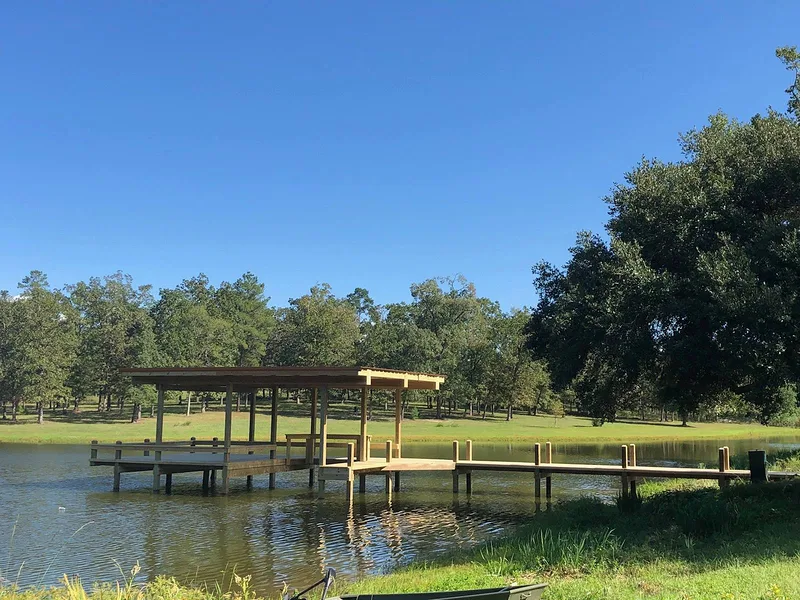
Covered timber pier head with a roof over the seating area and an open plank walkway running back to the bank
What Actually Helps

Four levers, in order of size.

1

Specify the lightest colour you can live with

The biggest variable, and it costs nothing. Get samples onto the dock in afternoon sun before ordering.

2

Roof the route people walk

Shade removes the problem rather than reducing it. A covered boathouse deck takes the walking line out of the sun entirely.

3

Prefer heat-reflective pigments, and hold their numbers loosely

MoistureShield states CoolDeck boards stay "up to 30° cooler than leading competitors' composite deck boards with heat mitigating technology," footnoted "when compared to competitor's deck boards of similar or lighter brightness (L* value)" — a comparison against other heat-mitigating composites, not against wood and not against composites generally.

4

Hose it down

Immediate and free. Then the bottom line: on an unshaded dock at three in the afternoon in August, no decking material is pleasant barefoot, timber included.

The Number That Decides Everything

You are buying the joist spacing, not the plank.

Composite is a surface spanning between stringers. What it carries is set almost entirely by how far apart they are.

At the L/180 deflection limit the WearDeck 5/4x6 is listed at 1,570 psf over 12-inch centres, 665 psf over 16, and 195 psf over 24. Identical plank — an eightfold spread from spacing alone, and the reason marine specifications tighten centres rather than upgrade boards. Read those against the rating, not instead of it: Table 4's figures sit at a temperature factor of 1.0, while the report's ASTM D7032 span rating in Table 3 — 24 inches at 100 psf — is the one adjusted for high temperature and freeze-thaw. In a Texas July, 100 psf is the honest number.

It is why re-decking an existing frame so often fails. Most brands cap a straight-laid board at 16 inches on centre and drop to 12 for a 45-degree lay, because the diagonal lengthens the span the board crosses. Many Texas lake docks were framed at 24-inch centres, which suits treated 2x6 decking and will not take a 16-inch-rated board without adding framing. WearDeck at 24 is the exception. Stair treads are shorter again — 14 inches — and dock steps are where that gets forgotten.

Name the paperwork correctly, because the shorthand in circulation is wrong. ASTM D7032 is the product standard. An ICC-ES evaluation report and a DrJ Engineering duly authenticated report are two routes to the same acceptance, and WearDeck's is the latter — Listing 2311-03, revised 18 February 2026 and subject to renewal 1 April 2027, under ANAB ISO/IEC 17065 accreditation. Its footnote matters on a dock: those span ratings do not account for UV or moisture.

Over Water, Brand by Brand

"Rated for water" means five different things.

Five composite brands, five positions. The sixth product here is not a composite.

Owens Corning WearDeck

Wood-free: HDPE reinforced with fibreglass, containing no wood or cellulosic materials, so there is nothing in the board for fungus to feed on even at a cut end. Note what the warranty does not say: no submersion statement at all.

MoistureShield

The strongest documented position of the mainstream brands: boards may be installed on the ground, in the ground or underwater without voiding the warranty. But it does contain wood fibre — the claim rests on encapsulation, not absent cellulose.

Trex

Marketed hard for docks, with a capped surface and a deliberately uncapped underside for airflow. The warranty is quieter, excluding fade and stain anywhere but the walking surface — naming the underside and ends, the faces a dock board shows water.

Fiberon

More conservative than its competitors, and worth quoting precisely: its marine page describes tolerance of intermittent water contact, not submersion.

TimberTech

Its composite warranty covers fade and stain only, is written for a single-family residential homeowner, and puts fitness for the application on the buyer. For a dock, prefer its PVC lines.

Sure-Step — not a composite board

Polypropylene, from Perspective Products, and an interlocking panel rather than a plank. Its open chevron web passes water, wind and light — less to lift against on a rising lake.

Capped, Uncapped, Or Neither

A cap is a shell, and a saw is a breach.

Conventional wood-plastic composite carries wood flour, which gives fungus something to feed on wherever the cap is broken. Every rip, mitre and pilot hole is a break, and once it is in the core it is close to impossible to get out.

That is the history behind capping becoming the norm — first-generation non-shelled boards drew a class action that settled with the manufacturer denying the allegations, and that line was discontinued years ago. Background, not a complaint about anything sold now.

What has not changed is where the risk sits in the paperwork. Trex and TimberTech both exclude mould and mildew as an environmental condition, and Trex states outright that both can grow on any outdoor surface, its own product included. So there are two structural answers over water: no cellulose in the board, or full encapsulation through the section — not a surface cap.

Boathouse deck nearing completion, new decking laid out across the framing beneath a finished roof with open lake beyond
Hardware And Movement

Two schedules that decide how it ages.

Fasteners and gaps are where a good board gets installed badly. Both are rated numbers.

1

Stainless, and only stainless

Coated deck screws do not belong on dock decking in any water. In fresh water 304 will serve and 316 lasts longer; in salt, 316 only. One coated screw bleeds rust into the board, and rust staining is excluded from every warranty here.

2

The screw changes the rating

Head pull-through is tested per fastener: the WearDeck 5/4x6 lists 235 lbf with one composite screw, 265 with a 316 stainless, 280 with a 305 stainless. On a lake that floods, that number is what holds a deck down.

3

Clips in the field, screws where it matters

Hidden clips give a clean surface and consistent gapping, but a repair means cutting boards out. Face screws resist lateral movement and let a damaged board be swapped in minutes. So: clips through the field, face screws at perimeters, stairs and wherever uplift is real.

4

The gap is a decision made that morning

Composite moves more than wood, and more along its length than across it, so end gapping matters far more than side gapping — about a quarter inch when the boards go down near 35°F, tightening as the day gets hotter, but never below the board's own published minimum. WearDeck's listing sets that floor at 1/16 inch end-to-end and side-to-side, with 3/16 inch recommended, so the manufacturer's minimum governs the hot-day end of the range, not a rule of thumb. Improper gapping is the first exclusion in TimberTech's warranty, and across a Texas working year it is a per-day call.

What Actually Goes Wrong

The failure modes, and where the warranty stops.

None of these are reasons to avoid composite, only to know what you bought.

The one-week cleaning clock

Trex and TimberTech both condition stain cover on the substance being removed with soap and water within one week. Fish blood, sunscreen, fuel and bait are the realistic offenders, and rust, grease and oil are excluded regardless.

Scratches do not sand out

The cap layer is the finish, so sanding through it removes the protection the board was bought for. TimberTech goes further than excluding the damage: a surface punctured by a sharp-edged tool voids its warranty.

Uplift in a flood

A solid deck over water traps air and water beneath it and can be lifted bodily off its frame as a lake rises. A fastener-schedule problem, solved on the drawing — and the case a through-flow panel answers.

Slip resistance is a word, not a rating

WearDeck's measured static coefficient of friction under ASTM D2394 is 0.38 dry and 0.43 wet along the board, 0.33 dry and 0.42 wet across it — both below the 0.5 figure commonly cited as a benchmark. We will give you the number and the test, not the adjective.

How We Build It

Composite over heavy full-dimensional timber.

The surface gets shopped. The frame is what an owner lives with.

Side view of a two-level private pond swim deck whose entire base is a driven corrugated galvanized sheet-pile cell, with timber swing arms rigged above the deck Upper observation level of the private pond swim deck, railed and carried on braced timber posts above the main deck Ramped approach running down the side of the private pond swim deck, with wire-mesh infill railings either side

Two products appear by name on our own pier drawings: WearDeck and Sure-Step. Wood-free is why one is on the sheet, the through-flow panel is why the other is, and the stringers are sized to suit that panel rather than a board's rating. Take that as our own framing standard for it, not a published manufacturer figure. Those sheets are shown at full resolution here.

The private pond swim deck above is the clearest example of the order we work in: a closed cell of driven galvanized sheet piling, filled around composite reinforcement bar, carrying a braced two-level timber structure, an upper deck, a stair and a ramped side. All settled before anyone chose what people walk on. The full build is written up here.

Our guarantee typically runs 2 to 5 years on the large Texas and Louisiana lakes and up to 10 years on private ponds and small lakes, with the terms set out in your agreement for the job. What sits behind it is not the decking — it is the pile, the framing and the hardware, the subject of Built to Last. Which is why a re-deck enquiry starts with a tape on the joists.

Finished in Composite

What it looks like when it is done.

Composite over heavy full-dimensional timber: the boards you walk on, the frame underneath doing the work.

A finished composite boathouse deck in dark brown boards, stair and bench in frame, open lake beyond the slip A composite boathouse deck with fixed bench seating and a picnic table under the roof, looking out over open water A composite-decked walkway running out over the water to a covered structure, timber posts and handrail either side
Questions We Hear Often

Composite Decking FAQ.

Is there a composite dock board that runs cool in the Texas sun?

Cooler than another composite, sometimes. Cool, no. MoistureShield states its CoolDeck boards stay up to 30 degrees cooler than leading competitors' composite deck boards with heat mitigating technology, footnoted when compared to competitor's deck boards of similar or lighter brightness. That is a comparison against other heat-mitigating composites, not against wood and not against composites generally. Colour is the bigger lever, shade bigger still.

What joist spacing does composite dock decking need?

Tighter than the frame under most older Texas lake docks. Mainstream brands cap straight-laid boards at 16 inches on centre and drop to 12 for a 45-degree lay, because the diagonal lengthens the span the board crosses. WearDeck is the exception at 24. We measure the centres first.

What fasteners belong on a composite dock deck?

Stainless, and nothing else. Fiberon instructs stainless in water applications and Owens Corning recommends it for corrosion resistance. In fresh water 304 will do and 316 lasts longer; in salt, 316 only. One coated screw bleeds rust into the board, and rust staining is excluded everywhere.

What does a lifetime composite warranty actually cover?

Less than the word suggests. Owens Corning defines its limited lifetime as the lifetime of the original purchaser's ownership of a single-family detached home, states plainly that it is non-transferable, and gives every other property type 25 years. Full cover runs 24 months, and excludes tear-out and disposal even then.

Will composite dock decking fade in the Texas sun?

The boards will change colour, and the warranties say so by excluding it. Owens Corning excludes any variations in the original colour, including fading, discoloration and spotting. Trex and TimberTech exclude the underside and ends of a board, which on a dock are the faces the water sees.

Start With a Conversation

Thinking about composite on a dock?

Send Dave a photo of the framing from underneath and a tape across the joist centres. That tells us more than an hour on colours.