Light cantilevered wall
Protected coves, low banks, short fetch, little height from mudline to cap. The sheeting stands on its embedment alone — where a shoreline carries no real load, that is correct, not a compromise.

Boathouses, bulkheads at four distinct levels of construction, and the decks and walkways that connect the house to the water — for the family that owns the shoreline they are standing on.
Private individuals and families — one house, one shoreline, one boathouse. Boards, developers, cities and public agencies want the commercial side instead.
A public pier is bought by a purchasing agent against a written specification. A family's waterfront is decided by walking the bank with the people who will be standing on it every summer.
If you have wondered whether one house is too small a job for a company that also builds marinas and public piers — it is not. Single-family waterfront is the core of the business, across more than 40 years, 250-plus boathouses and 850-plus projects. It comes down to boathouses, bulkheads at several genuinely different levels, and the decks and walkways that tie both back to the house.

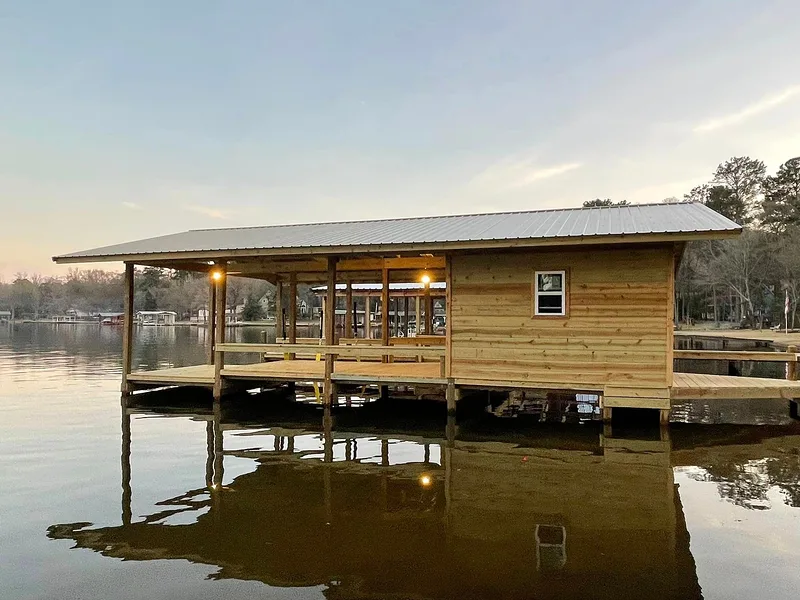
Covered slips, lifts, roofs shaped to move heat, and the deck the family lives on. See boathouses.
Not one product with one price. The step from a light wall to a properly anchored one is the biggest decision most owners make.
Stairs down a bank, a walkway across wet ground, the deck at the end. See decks and boardwalks.
A bulkhead is graded by what is pushing on it, not by the length of the run. Four levels cover almost every residential shoreline.
Owners collect a few numbers per linear foot and assume the walls behind them are comparable. They usually are not. Two quotes on the same lake can differ in the stiffness of the sheet, how far it is driven below the mudline, whether there is any anchor at all, and whether water behind the wall can get out. Lightest to heaviest:
Protected coves, low banks, short fetch, little height from mudline to cap. The sheeting stands on its embedment alone — where a shoreline carries no real load, that is correct, not a compromise.
The common grade. Sheeting, a wale, rods running back to buried anchors, a finished cap. Once a wall holds a real yard rather than a low bank, this is where it belongs.
Taller walls, deeper water, longer fetch, softer ground. A stiffer sheet, deeper embedment, closer rod spacing, larger anchors, and a drainage path designed rather than assumed.
Full-dimensional timber on driven piles, built the way commercial shoreline work is built. For long fetch, high banks, or a house close enough that the wall holds the house.
Three shorelines, three levels of construction. What no photograph shows is the embedment below the waterline or the anchors buried in the yard — where most of the difference lives.
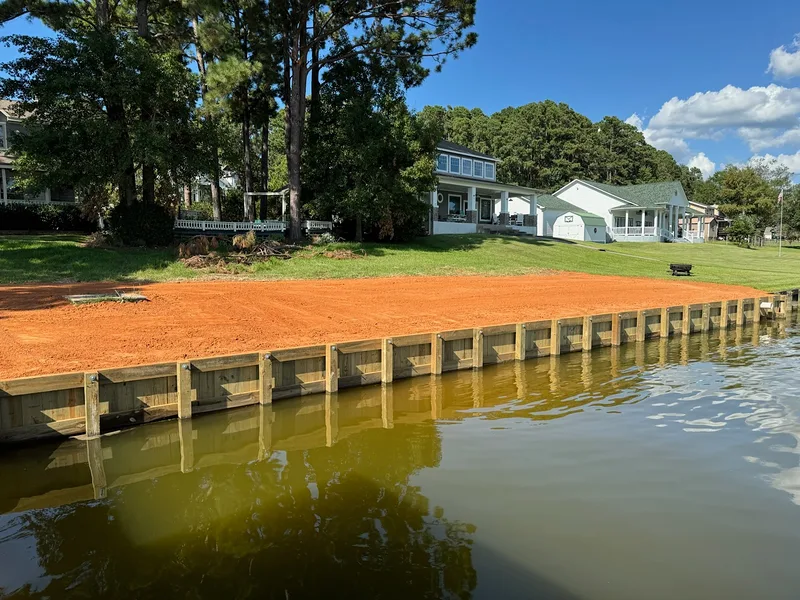
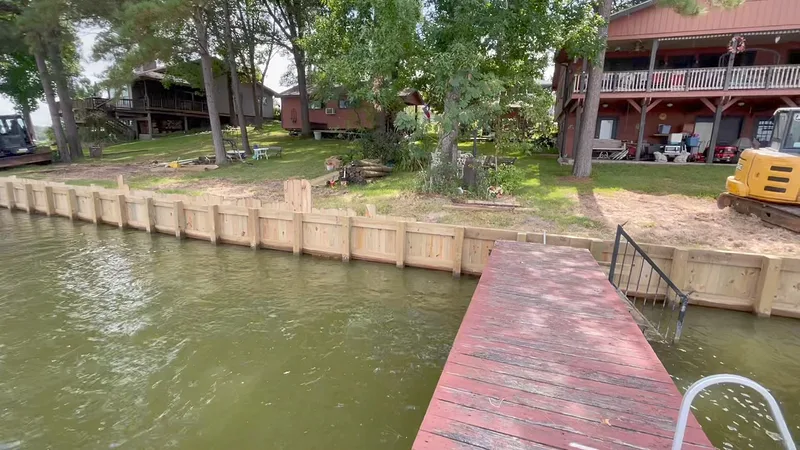
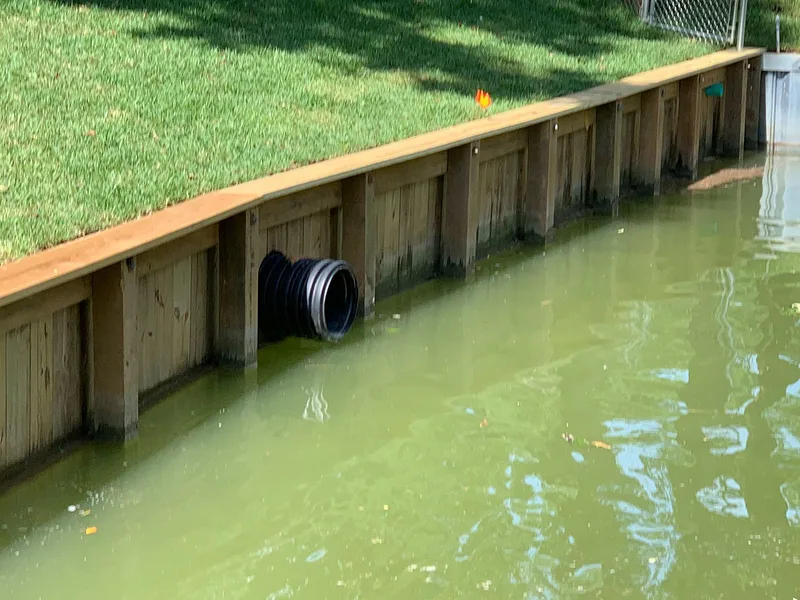
Material gets the attention; thickness gets almost none. Ask what section is quoted, not only what it is made of. A light one on a tall wall bows long before it breaks.
The hardest-working part of a bulkhead is both underwater and underground. A wall with no rods stands only because soil in front of its buried toe pushes back.
The largest step between grades. Past a certain height and load, no sheet thickness substitutes for carrying the load back into ground that is not moving.
A buried timber or concrete deadman, or a screw anchor turned in where there is no room to trench and no wish to lose the lawn.
The part everyone sees, so the part most often thinned to make a number work. It locks the sheet tops together and keeps weather off end grain.
A light wall in sand drains through its joints. A tall wall against Texas clay needs a route out — weeps, free-draining backfill, and fabric so the yard stays put.
None of the six is exotic, and all are easy to leave out of a number. The load theory underneath them is on Built to Last.
You can get most of the way there yourself, before anybody quotes anything.
Start with height — mudline in front of the wall to the top of the cap. That number moves a shoreline between grades faster than anything else. Then fetch: how far open water runs at you in the direction the wind usually comes from. Then what sits behind the wall, because mown yard is one thing and a patio, a driveway or a slope running into it is another. Then drawdown, which leaves saturated soil behind a wall with little in front of it.
If there is already a wall there, it has been running the experiment for you. A face leaning out at the top, a cap opened at the joints, or a soft low spot in the lawn tells you the answer.
Treatment is graded too. Retention — pounds of preservative left in a cubic foot of wood — is set by exposure, and by which preservative is doing the work. For CCA it runs roughly 0.25 pcf above ground, 0.40 for ground contact and fresh water, 0.60 for structural poles, 2.50 for saltwater immersion. Copper azole and ACQ carry their own, much lower, numbers for the same exposures, so the use category is the thing to specify, not the figure. Doses, not grades of quality. Worth knowing too that CCA has not been available for most residential work — decks, walkways, boardwalks, fencing, landscape timbers — since the end of 2003.
AWPA puts non-marine bulkhead sheathing in Use Category 4A — ground contact and fresh water — and freshwater piling in 4C, at 0.80 pcf CCA. The marine categories, UC5, are the ones that exist because of shipworms and gribbles, and those do not live in Lake Livingston. Saltwater-grade timber on a lake is building above the requirement, not up to it.

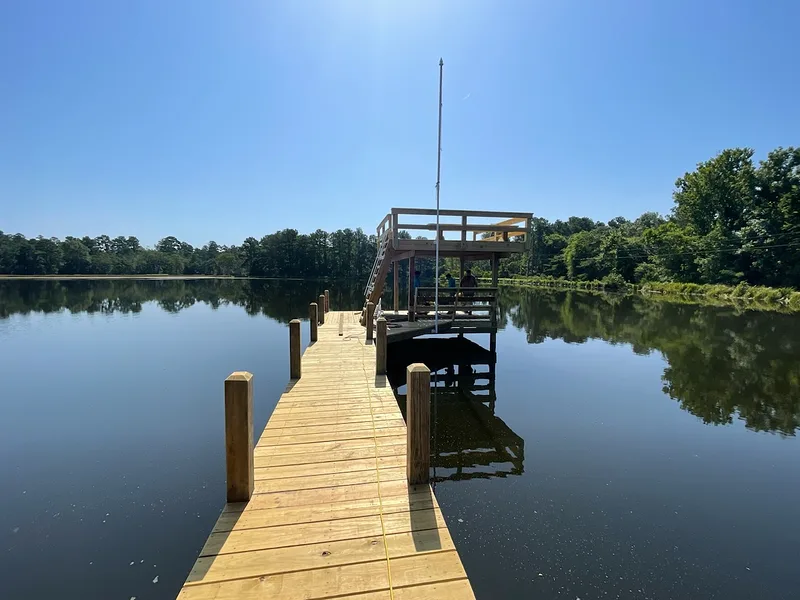
Steps down a bank, a walkway across wet ground, and the deck at the end of it.
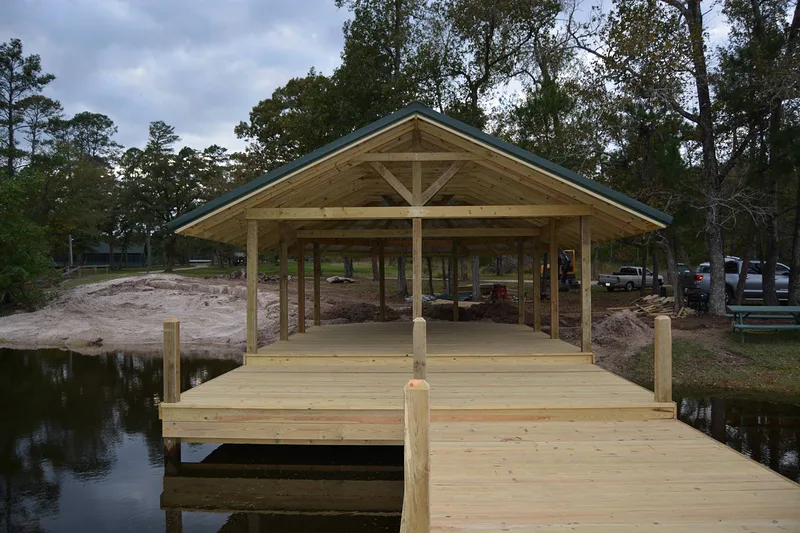


Composite is the default surface on residential work now. Not because it is cheaper up front — board for board it still is not — but because there is no sealing cycle, no splinters under bare feet, and no wood flour for a fungus to feed on. The full argument is on the decks and boardwalks page.
Be clear about what it is: a surface. It spans stringer to stringer and carries nothing else — it does not stiffen a frame or make a weak structure strong. The timber underneath still decides how long the thing stands, which is why our composite decks go over heavy full-dimensional timber. Two recent examples: a boathouse on Houston County Lake, northwest of Crockett, and one on Lake Nacogdoches.
Spacing follows the board, not habit. We frame at 18-inch centers where the panel we are laying is rated for it — the Sure-Step panel on our pier drawings is one — while most straight-laid composite boards cap joist spacing at 16 inches, and Owens Corning's WearDeck is rated to a 24-inch maximum span. Different products, different numbers; we read the one we are actually buying.
We will not call composite maintenance-free or say it lasts a lifetime. The manufacturers exclude fading and normal wear from their own warranties, those warranties are theirs rather than ours, and the category is not old enough for long-run field data. What is fair to say is that a wood-free board holds no wood flour for fungus to feed on.
No showroom, no catalog, no package tiers. A phone call, and then a walk along your bank.
Call Dave and describe the property. What he asks for is specific: mudline to the top of the bank, what stands behind the wall, which direction the open water runs from, how far the lake moves across a year, and what is already built. Photographs from the water looking back beat any description of it.
Back comes a straight answer — which grade of wall the shoreline needs, whether the boathouse and the bulkhead are one project or two, what happens first. If the existing wall has years left in it, that is what you will hear.
No. Single-family waterfront is the core of what Shoretech builds, and has been for more than 40 years.
Four, in practice: a light cantilevered wall standing on its embedment alone; a tied-back wall with a wale, rods and buried anchors; a heavy wall with a stiffer sheet, deeper embedment and designed drainage; and a heavy timber bulkhead on driven piles.
Height from the mudline to the top of the cap is the first test, then what sits behind the wall and how that soil drains. A wall standing on embedment alone only works where the load is small.
It is more treatment than the standard asks for. AWPA puts non-marine bulkhead sheathing in Use Category 4A — ground contact and fresh water — and the marine categories, UC5, exist because of shipworms and gribbles, which do not live in a Texas lake. Building above that is fair; it is not required.
Usually — not on first cost, which is still higher, but because it drops the sealing cycle and the splinters. We will not call it maintenance-free or put a service-life number on it — the manufacturers exclude fading and normal wear from their own warranties, and the category is not old enough for field data.
Yes, and it usually sequences better that way — the wall and the backfill have to be settled before the deck and the approach are set.
Water level, bottom, soil, and who permits the shoreline change from one lake to the next. Each has its own page. Service area, not a project list — ask Dave what has actually been built on yours.
Tell Dave about the property, the shoreline, and how you want to use the water. The design follows from there.