
Bulkhead & Seawall Repair · Texas & Western Louisiana
A failing bulkhead tells you what is wrong with it.
A wall tipping out at the top. A soft spot in the lawn behind it. Daylight between panels. A cap moved off line. Rust weeping at the waterline. Five symptoms, five different causes — and only some mean the wall has to come out.
Bulkhead, Seawall, Retaining Wall
Same wall, different words for it.
Locals say bulkhead. Buyers from the coast say seawall. On a Texas lake they are the same structure, and this page answers to both.
Nearly everything written about seawall failure online was written for saltwater — tidal drawdown, storm surge, weep holes — and usually ends by selling foam injection. A wall on a managed freshwater lake fails for its own reasons: groundwater pressure in the backfill after rain, soil migrating out through the wall, anchors corroded or never long enough, and timber and steel giving up in the narrow band at the waterline.
This page is the diagnosis. Construction detail lives on the bulkheads and retaining walls page; the twice-a-year inspection routine is in Built to Last. This is the step after that walk.
The Idea Behind Every Diagnosis
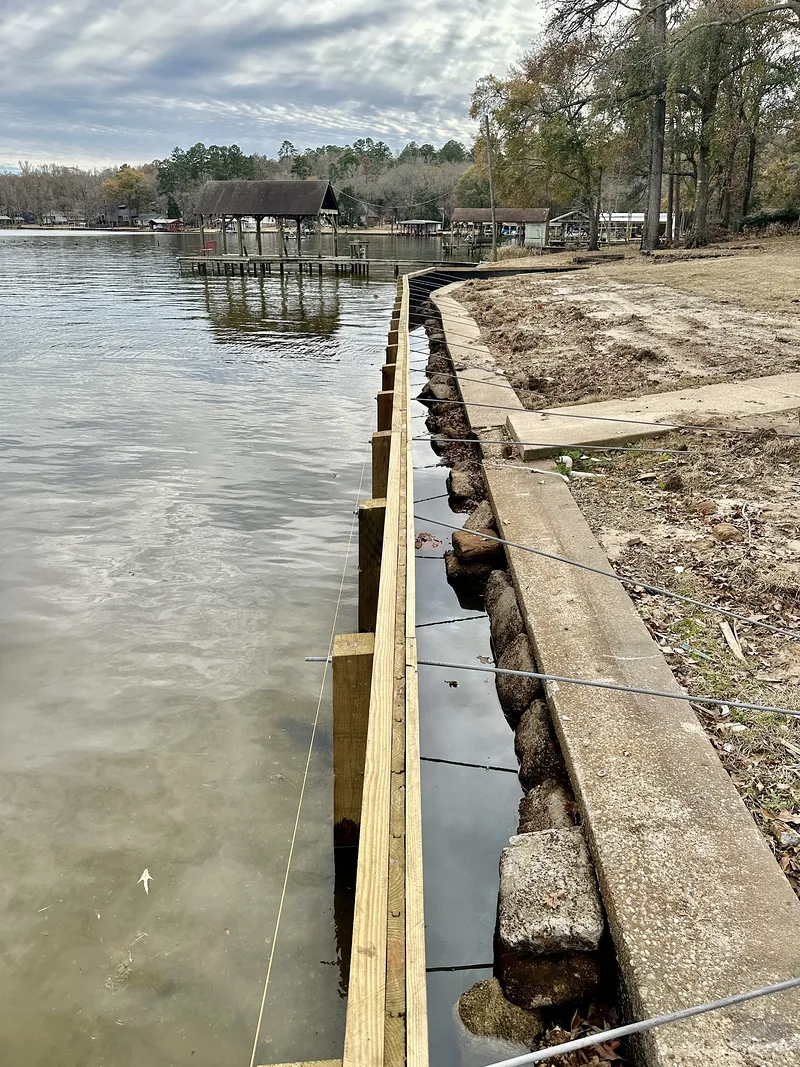
Your wall is two structures, and one of them is buried.
The face you can see, and the anchor system behind it that stops the face rotating. They age separately, and one routinely outlasts the other.
The face resists the soil; the tie-backs and deadmen buried inland resist the moment that soil applies to the top of it. Take the anchors away and even a sound face rotates out. Which is why how bad a wall looks is the wrong first question — one that looks respectable from a boat can be nearer failure than an ugly one holding its line.
Reading the Symptoms
Five things owners find, and what each one means.
Photograph anything you are unsure about, at low water if you can, and note the date. What gets read is change over time. There is a longer version of this walk — eight signs your bulkhead is failing, each with a verdict on whether it can wait.
1
The wall is tipping out at the top
Sight down the cap from one end. Base still where it belongs, top rotated toward the water: the signature of an anchor system not doing its job — corroded rods, deadmen too short or set into ground gone soft, a split wale no longer spreading load. The force behind it is usually groundwater in the backfill after a wet spell, not wave attack. Severity: establish whether it is still moving. Which direction it leans narrows the cause considerably: why a bulkhead leans works through the three patterns and how to measure them.
2
A sinkhole or soft spot in the lawn behind it
Fines are escaping through the wall and the ground is arching over the space they left. What you can see is nearly always smaller than the void under it — which is how a mower wheel finds its real size. Severity: call about this one first. Closing the route while it is small beats rebuilding a hollowed-out bank.
3
Daylight or open joints between panels
Sheet piles are only a wall because they lock into one another; a separated interlock is a full-height channel from your yard to the lake. In a timber wall it is a gap opening between planks or at a butt joint. The opening and the depression behind it are the same story twice. Severity: neither improves on its own.
4
The cap has moved
A cap ties the panel heads together and spreads load along the run rather than into single sheets. Cracked at a joint, lifted off its fasteners or stepped out of line, it is reporting movement underneath. Re-capping without finding the cause replaces the evidence. Severity: resist tidying it before it is looked at.
5
Rust or rot weeping at the waterline
The alternately wet and dry band is where both materials go first. On galvanized steel a white powdery deposit is the zinc working; red staining, scale and pitting mean the zinc is spent and the steel is being consumed. On timber it is decay in the same band, and the fasteners often go before the wood. Severity: this is about remaining section — no paint puts section back.
Repair, or Replace
The line between them is real, and it is not about appearance.
Repairable looks like this: a sound face, movement confined to part of the run, joints still closed, and either intact anchors or ground behind that will take new ones. A split wale, a displaced cap, a failed anchor, a short length undermined at the toe. Backfill loss is fixable once the route it left by is closed.
Past repair means the wall has lost the things a repair would attach to. Interlocks separated over a run. Section gone through the steel at the waterline. Timber the fasteners no longer have sound wood to hold. Rotation far enough that pulling the wall back would drag it through soil already collapsed behind it.
Authorization and mobilization do not scale down with the length of a wall the way materials do — which is why we say which of the two you have before anything is priced. The full set of tests, written out so you can check the answer you are given, is on bulkhead repair or replace.
How We Assess a Wall
Four things established before anyone talks about scope.
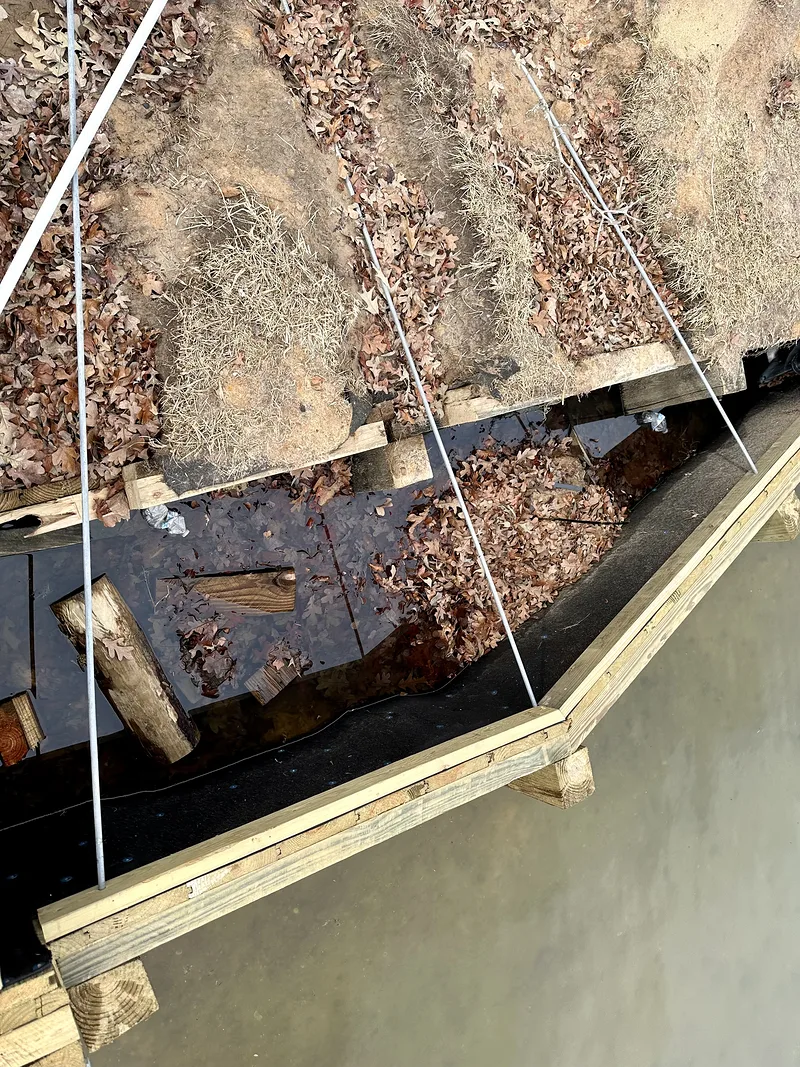
Most of it happens on the bank in an hour or two, and none of it can be done from a photograph — the honest reason a phone quote would be a guess.
1
History, then lean measured at stations
When the movement was first noticed, whether it has moved since, and what happened just before it changed. Then the run is sighted and the tilt recorded at several points against a reference we can find again. One reading describes a wall; two say whether this is a repair or an emergency.
2
Finding the anchors
What type, how far back, at what spacing, and what condition the rods are in where they can be reached. This decides most jobs, and nobody can see it from the water.
3
Probing behind and in front
Behind the wall for voids and how far they run; in front for depth and for what the bottom will hold. A wall on Lake Livingston and one on a private pond are not driven into the same material.
4
Where the water goes, and who approves the work
How the yard sheds, whether any filter path is left behind the wall, and whether a downspout or a neighbour's grading is loading your backfill — a wall rebuilt without fixing that fails the same way twice. Then which body controls the shoreline at your elevation.
The Part Owners Get Wrong
Replacing a wall is permitted like building one.
Many owners assume putting back what was there counts as maintenance. On the lakes we work, it does not.
The San Jacinto River Authority says it directly in its Lake Conroe rules: it is a violation to install, re-install, replace or modify bulkheads in the reservoir or on Authority land except in strict compliance with a valid permit. SJRA uses both words, and it is worth knowing which door you are at: it titles its pages Licensing My Residential Structure and Permitting My Bulkhead, and files a dock and a wall as separate applications — even though its own overview sentence lists residential bulkheads under licensing. A dock authorization does not cover a wall. On Lake Livingston the water end of your wall sits on Trinity River Authority property, and TRA runs bulkheads under its own bulkhead authorization — a separate application from the boathouse and pier route. Deed restrictions stack on top, and an SJRA permit is void if the work breaches them.
That shapes the repair decision, not just the paperwork. If you are unsure who controls your shoreline, start there.
Where We Do This Work
Forty years of watching walls fail on the same water.
Based in Trinity, building waterfronts for more than 40 years — over 250 boathouses and 850-plus projects.
Service area
- Texas and western Louisiana waterfronts
- Private ponds and small lakes
- Subdivision, association and commercial shoreline
- Dave travels as far as the work requires
Authorization, not completed work. Lake Lewisville is not on the list above, but one authorization there is worth naming, because it is about failed walls specifically: on Lake Lewisville the U.S. Army Corps of Engineers had stopped permitting shoreline reinforcement after years of walls failed. Shoretech is currently the only contractor they permit to build steel or heavy timber bulkheads there, and that authorization runs through the end of December 2027. It does not make permitting automatic — your own shoreline still has to qualify, and what the Lewisville shoreline permit process asks for is set out separately.
Questions We Hear
Bulkhead repair FAQ.
How do I know if my bulkhead needs repair or full replacement?
By looking at the anchor system rather than the face. A wall with a sound face and movement confined to part of the run can usually be re-anchored, re-waled and re-capped. One that has rotated far enough to open its joints, or lost section through the steel at the waterline, is past that. The test that matters is whether it is still moving.
How far can a bulkhead lean before it has to be replaced?
There is no universal number, and be wary of anyone who gives you one without measuring your wall. Two walls tipped out the same amount can be in completely different trouble: one on intact anchors simply set too short, the other with no working anchors left. We measure the lean at several stations against a reference we can read again.
Why is there a sinkhole in my yard behind the bulkhead?
Because soil is leaving through the wall. Water escaping through an open joint, a separated interlock or a gap under the toe carries the fine material with it, and the coarser material arches over the space left behind. That is why the visible depression is nearly always smaller than the void under it, and why topsoil only feeds the same route.
Can you replace just the failing section, or does the whole wall have to go?
Often a section is the right answer, and we say so when it is. What decides it is whether the rest of the run has real life left, and whether a clean structural joint can be made at each end of the new work. A new section is also stiffer than the old wall either side, so load goes looking for the next weak point.
Do I need a permit to repair or replace a bulkhead?
Usually yes, and owners are often surprised that replacing an existing wall counts as new work rather than maintenance. The San Jacinto River Authority states in its Lake Conroe rules that it is a violation to install, re-install, replace or modify bulkheads except in strict compliance with a valid permit. Deed restrictions can sit on top of that.
Why can't you quote bulkhead repair over the phone?
Because the half of the wall that sets the price is the half you cannot photograph: anchor type and condition, how far back the deadmen sit, how much soil has already left, and what the bottom in front will hold. Our guarantee typically runs 2 to 5 years on the large Texas and Louisiana lakes and up to 10 years on private ponds and small lakes, with the terms set out in your agreement for the job.
Read Next
The rest of the wall conversation.
Before It Gets More Expensive
Send photographs, then have Dave walk it.
Photographs down the length of the cap, and of anything odd in the yard behind it, start the conversation. What settles it is an hour on the bank finding the anchors, probing the backfill and reading the drainage.