Which boats, not how many slips
The fleet you have and the one on your waiting list set finger length, spacing and freeboard. Decide the boats and the count falls out of it.

Slip layout and small-slip conversion. Walkways, fingers and gangways. Fixed or floating. Pile and bulkhead work at the scale a basin needs, utilities out on the dock, and a sequence written around your season rather than ours.
Every slip is a line of revenue sitting on something that will eventually have to be replaced.
Marinas rarely get rebuilt because somebody wanted a nicer dock. They get rebuilt because the piles under the main walkway have gone soft at the waterline, because the slips no longer fit the boats members own, or because a run of fingers has been roped off for two seasons.
This page is about the structure: what gets built, what gets kept, and in what order. Depth is a separate problem — if the basin has shoaled, that is marina dredging, and sequence matters: there is no sense decking over water you are about to bring a barge into.
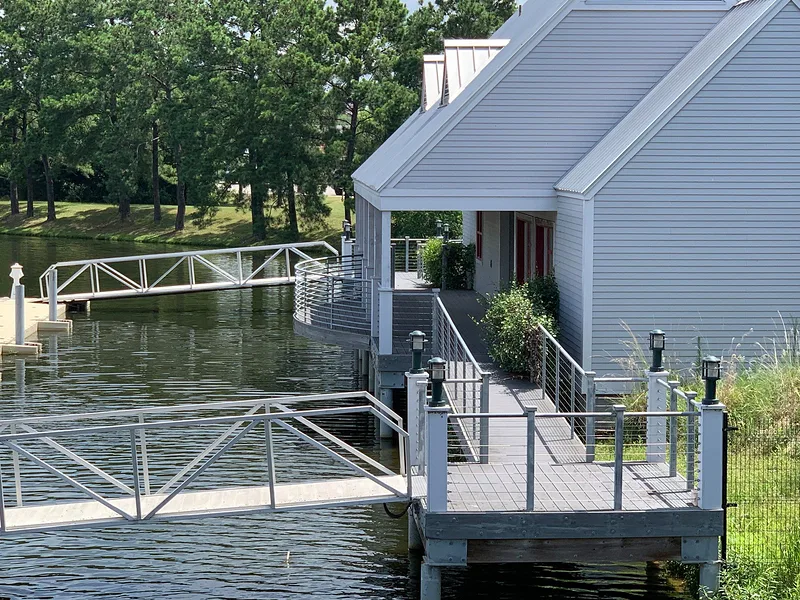
How far your water moves in a normal year sets almost everything downstream of it.
A fixed marina is pile-supported: bents driven into the bottom, decking set at one elevation, slips that never move relative to the shore. It is stiff, takes crowd loading and hand carts without complaint, and is much the easier structure to roof or run a service line along. What it cannot do is follow the water.
A floating marina does exactly that. The fingers hold the same height above the surface all year, and the link to shore is a gangway that pivots at the top and rolls at the bottom. The trade is stiffness and restraint: floats have to be held against wind and wake by guide piles or an anchor system, and the gangway steepens as the lake falls — slope and length settled before anything is ordered, not discovered in a dry September.
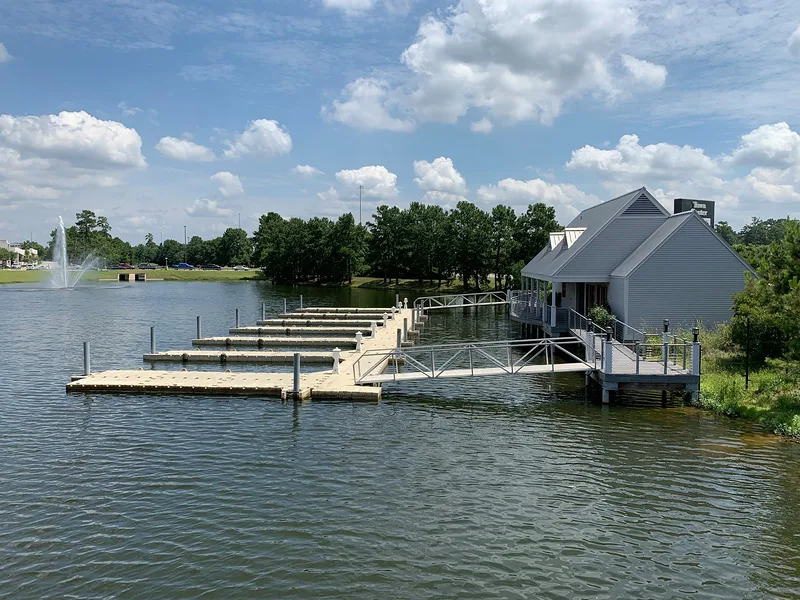
Most working marinas end up mixed: a fixed spine carrying the foot traffic, floating fingers carrying the boats.
The most consequential drawing in the set, and the one operators inherit rather than choose. Slip count is not the goal — occupancy is. A basin laid out for a thirty-year-old fleet often holds fewer boats than its water will take, and reworking finger spacing raises the count inside the approved footprint.
Used by everybody, specified by almost nobody. A walkway has to let two people pass with gear, take a loaded hand cart and stay walkable wet. A gangway has to work at every level the lake produces, which makes its length and landing elevation a design decision, not a catalogue pick.
Everything above the water lasts exactly as long as what is under it, and piles are the hardest thing to change later. On a rebuild this is the first assessment: what the existing bents have left, and whether your layout lands its loads where something is already there to carry them.
The shoreline behind a marina holds the parking, the ramp approach and the ground people cross between car and dock — a continuous run rather than a patched one, an anchor system sized for what sits behind it, and a cap tying the line together. Failures here show up first as a soft spot in a parking lot; detail lives on the bulkheads page.
Pedestals, potable water, lighting and their conduit are far cheaper planned into the framing than hung under a finished deck. We frame and route for them as part of the structure and coordinate with the trades who terminate and sign for the electrical work.
An aging 1980s marina replaced with a new small-slip layout, at a resort that could not simply shut for a season.
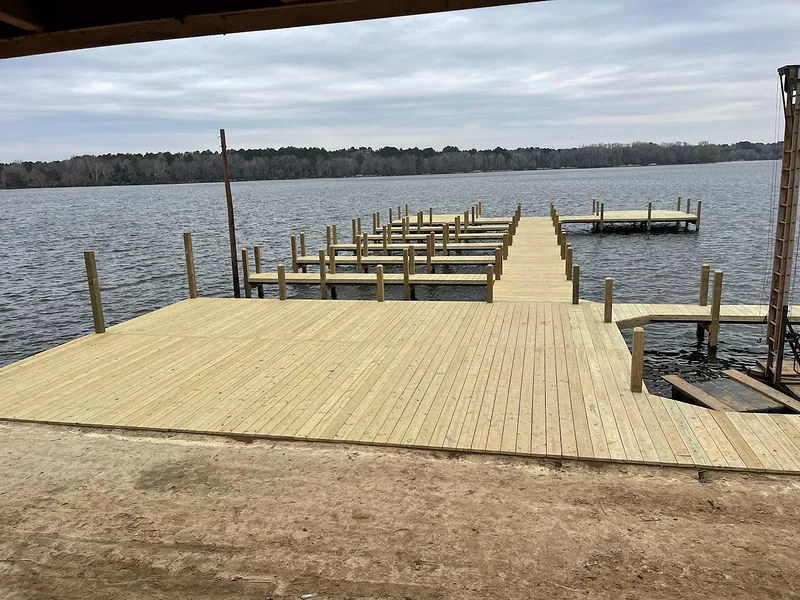
Shoretech replaced the marina at Crockett Family Resort — the worn 1980s structure out, a new small-slip layout in its place, with demolition, pilings and decking sequenced so the resort kept usable water through the job. The resort is a TPWD-listed private access point on Houston County Lake, with a boat ramp, boat gas, cabins and 116 RV spots. Working infrastructure, not ornament, which is why the schedule mattered as much as the drawings.
The lake made the structural call easy: its conservation pool moves only a foot or two in a normal year, so a fixed, pile-supported deck could be built tight to a waterline that stays put.

Two approaches in most basins have no alternative route. Everything else can be taken in blocks.
The fuel dock and the single entrance have no substitute, so they come first or in the tightest window available. Interior slips can be worked a block at a time, and the block boundaries come out of your occupancy calendar — which fingers are empty in which weeks is information the operator has and the contractor does not.
Phasing usually means moving tenants inside the basin rather than off the water. The constraint is rarely the equipment; it is where the barge sits and which fairway stays clear. Off-season sequencing is simpler because larger blocks can be taken at once — an operations argument, not a discount. An honest plan names the hard weeks too: not every marina stays fully open through every stage.
Each one changes the structure, and none is a contractor's call to make for you.
The fleet you have and the one on your waiting list set finger length, spacing and freeboard. Decide the boats and the count falls out of it.
Driven by how far the lake moves in a year, what you intend to roof, and whether equipment has to roll out onto the structure.
Putting the same layout back is faster. Re-planning is the only chance to fix a traffic pattern that has been wrong for twenty years.
A marina fails in sections, so the answer is rarely all or nothing. What the piles have left decides how much new work is worth attaching.
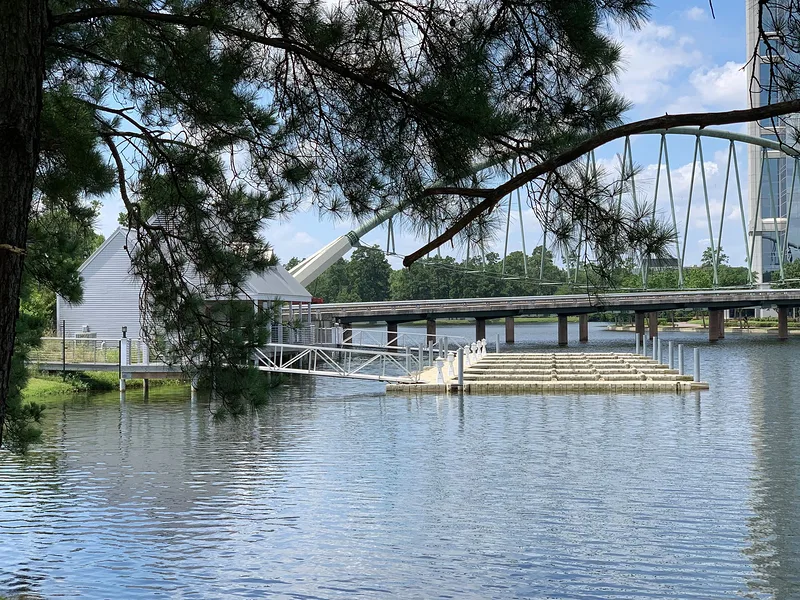
A marina is a far bigger structure on somebody else's bottom than a private dock, and is approved that way.
On the lakes we work, the water and the ground under it belong to a river authority or a federal district, and building over it is a permitted activity, not a right that comes with the deed. Footprint, depth and structure type are all things it has a view on, and because the authorization attaches to the facility, the operator or property owner is normally the applicant. A layout finalized before anyone asked what the footprint may be gets redrawn. If you are not certain who controls your shoreline, start there.
Based in Trinity, building waterfronts for more than 40 years — over 250 boathouses and 850-plus projects.
Dave will join a board call or walk a basin and say plainly which of the pieces above is forcing the schedule.
How far your lake moves in a normal year decides most of it. On constant-level water a fixed, pile-supported structure is stiffer and easier to roof. Where there is real seasonal drawdown, floats keep the step down into the boat the same all year, at the cost of an anchoring system and a gangway that steepens as the water falls.
Often, and it is one of the more common reasons to rebuild rather than repair. A basin laid out decades ago for a different fleet can hold fewer boats than its water will take, and reworking the finger spacing raises the count inside the same footprint. At Crockett Family Resort on Houston County Lake we replaced the aging 1980s marina with a new small-slip layout.
Both. A rebuild starts with what is already standing: what the piles have left and how much of the layout is worth keeping. Sections that are sound stay. Our guarantee typically runs 2 to 5 years on the large Texas and Louisiana lakes and up to 10 years on private ponds and small lakes, with the terms set out in your agreement for the job.
Normally the operator or the property owner, because the authorization attaches to the facility rather than to the contractor. The body that owns the lakebed also decides who may work on its water, so confirm that sequence before a layout is finalized.
Bring the occupancy calendar and the slip mix you wish you had. The earlier structure and schedule are discussed together, the fewer weeks the marina spends out of service.