Composite Decking
Splinter-free, low-maintenance decking rated for Texas sun and water.

From a simple swim pier to a multi-slip system, Shoretech builds and repairs docks engineered for water depth, fluctuation, wind, and wake — on Lake Livingston, Lake Conroe, Sam Rayburn, and waterfronts across Texas and Louisiana.
Lake levels rise and fall, wind drives wake, and the bottom is rarely what it looks like from shore. The right dock starts below the waterline.
We size piles and framing to the actual conditions — water depth and fluctuation, bottom composition, fetch, and how you'll use the dock. A pier that's still solid in twenty years is rarely the cheapest one to build, but it's almost always the least expensive to own.
Composite decking, proper hardware, and clean detailing keep a Shoretech dock looking right and working hard, season after season.
We repair docks, piers and boathouses as well as build them, and the same rule applies either way: a repair is worth doing when it restores the structure's strength, not when it only covers up the problem. New decking laid over piles that are already gone is a cosmetic answer to a structural question, and the lake will ask that question again. Where a roof and a lift are involved the components run on separate clocks, so boathouse repair is worked through separately.
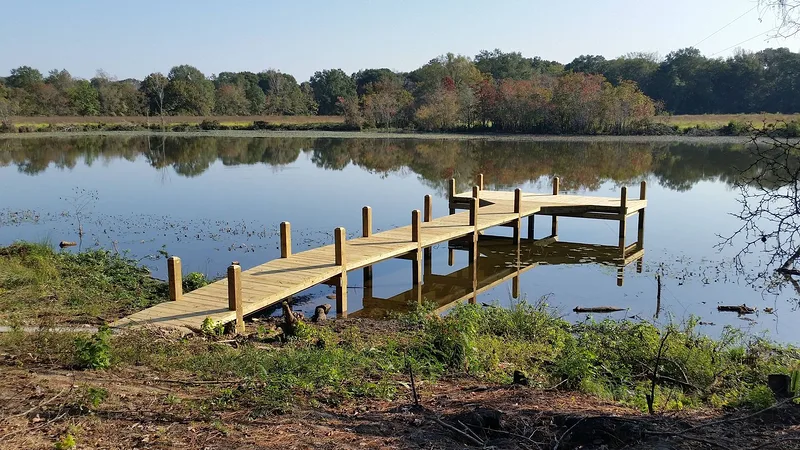

Driven-pile docks and piers for stable, long-span access where depth and bottom allow.
Properly anchored floating docks for big water-level swings and deep drop-offs.
From family swim piers to shared multi-slip and marina access docks.
Fishing piers, covered pier heads, and walkway piers Shoretech has built — the same piles, framing, and detailing behind every dock we put on the water.


Swim decks, swim platforms, family recreation decks and pond piers on private acreage — where the owner controls the bank, the water is fresh, and the level may still be rising.


On a big reservoir the shoreline is not yours. Every structure on it is built to what a permit allows, and the permit is written for the lake, not for you. A private pond inverts that. The water and the bank are privately held — by a single owner, or, as on the project below, by a lake association whose members hold them between them — and the federal shoreline permitting that governs a Corps reservoir generally does not reach private water of that kind. What that changes is not how carefully we build. It changes the ceiling.
The water is different too. A private pond is fresh, usually still, and it does not run the seasonal drawdown a reservoir does. Calm fresh water is far kinder to steel and timber than a wind-driven reservoir waterline, because it is wave action and flow that strip protective coatings and scour a wall's toe.
The third difference is the one that decides the design. A new pond is still filling. The shoreline you build to this year is not the shoreline you will have in three years, and every fixed elevation — deck height, ramp slope, ladder, the top of the wall — is a bet on a water level that has not arrived yet. There is no cheap second attempt on a structure whose foundation is driven steel. It has to be right the first time.
The deck above is a two-level family swim and recreation deck on a private multi-family freshwater lake, built by our own crew. Railed upper observation deck on braced timber posts, a main deck with room to sit, wire-mesh infill railings, a stair, a ramped approach, and two tall timber swing arms rigged out over the water.

Hot-dip galvanized sheet piling driven as a closed rectangle, 24 feet by 20 feet, with pile positions on three-foot centers. It is not a shoreline wall that happens to be near a deck — it is the foundation the whole deck stands on.
Inside the box, a predesigned mix of stabilized sand and a plasticized mortar mix. The plasticizer is what makes it flow: a closed cell leaves no room to work a compactor into the corners, so the fill has to reach every void on its own and then set. Placed that way it will not densify and settle the way loose fill does, and it cannot migrate out through a gap the way loose sand can. It is honest to call that fill and dishonest to call it concrete: it is not a footing, not a slab, and not a structural pour.
The fill is placed around a framework of composite reinforcement bar. Dave's rule on a job with the budget for it: no steel rebar. The reason is below, and it is a good one.
Thick-wall drill stem pipe piles, welded to angle iron, carry the gate and the ramped-down side of the deck. Salvaged oilfield pipe is high-yield steel with a lot of wall on it — which is exactly what a pile standing in water wants: metal to spare.
Both of these are worth understanding before you sign anything, because they are the difference between a structure that ages and one that comes apart.
Concrete does not protect steel rebar by covering it up. Fresh concrete is strongly alkaline, and that chemistry holds a microscopically thin film on the bar that keeps it from corroding at all. Everything that goes wrong afterwards is the story of that chemistry being ruined — usually by chloride working its way in to the bar. Once the film breaks down the bar starts to rust, and the rust is the real problem: corrosion products take up several times the volume of the steel they consumed. Locked inside hard concrete, that expansion has nowhere to go. It works like a slow jack and splits the concrete from the inside out. The bar loses section and the cover that was protecting it falls away, which is why failing concrete sheds sheets of material long before anybody touches it.
Composite reinforcement bar — glass fibre held in a cured resin — has no iron in it. There is no corrosion cell to start, so it cannot rust, and it therefore cannot generate the expansion that breaks concrete apart from within. That is the whole argument and it is strong enough on its own. Bar pulled out of fifteen- and twenty-year-old structures has come back with very little measurable loss. Nobody has a hundred years of field data on a material that has not been in the ground that long, and we are not going to pretend otherwise.
It is also not a drop-in substitute for steel, and any contractor who says it is has never designed with it. Composite bar is strong in tension but only about a quarter as stiff as steel, and stiffness — not strength — is what governs how far a structure deflects and how wide its cracks open under everyday load. That has to be designed for, which usually means more bar, more section, or both. It cannot be bent on site either: the resin cures once and for good, so every bend and hook is formed at the factory before it sets, and a change in the field means a new order rather than a man with a bending bar.
The piling is hot-dip galvanized 5 gauge steel — a little over three-sixteenths of an inch thick, the heaviest section in the light-gauge sheet range. Galvanizing protects steel two ways: it is a physical barrier, and it is sacrificial, corroding in place of the steel underneath. That second word is the honest one. Zinc is consumed. It is not a permanent finish; it is a very long head start. Not all galvanizing is the same, either. Sheet coated at the mill before it is formed and cut leaves every cut edge and weld bare; dipping after fabrication puts zinc on those edges too. This piling was dipped after fabrication — the dearer route, and the one worth asking any contractor about.
How long a head start depends entirely on the water. Zinc does well in hard fresh water, where calcium and magnesium build an insoluble scale that armours the surface, and much worse in soft or acidic water where that scale never forms. Flow and wave action scrub the scale off; still water leaves it alone. Published corrosion rates for zinc in fresh water span more than a tenfold range for exactly those reasons, and the galvanizing industry itself declines to publish a service-life chart for fresh water immersion at all. Anyone who quotes you a single number of years for galvanized steel in a specific pond, without testing that pond's water, invented it. What we will tell you is what the coating is, how much steel is under it, and which part of a structure wears first — the waterline, always, where wetting, drying and oxygen all arrive together.
Dave calls the finished thing a forever structure, about a job where the budget allowed every decision to be made for permanence instead of price. Those are his words and we will leave them as his. What we will put in our own voice is narrower and checkable, and it splits in two. Taking the steel out of the fill removes a failure mode outright: there is no iron in composite bar left to rust, so it cannot generate the expansion that splits the fill apart from within. The galvanizing only delays one. The zinc is real protection and it is spent as it works, and the waterline is where it goes first. Put together, that is a structure built to resist the failure that ends ordinary pond construction, sitting in still, fresh, privately held water, which is the kindest water any of it will ever see.
That is also where our longest guarantee lives. Our guarantee typically runs 2 to 5 years on the big reservoirs and up to 10 years on private ponds and small lakes — and a private pond is the up-to-10-year end of that range, for the same reasons the deck above was worth building this way.
One last thing about it: it is not finished being used. Dave's plan is to add a zip line alongside it in the wintertime, once the lake fills in further. The swing arms are already rigged and waiting. A deck standing on driven pile and a filled steel cell has the capacity for whatever comes next — which is the practical argument for over-building a foundation you only get one chance to install.
Splinter-free, low-maintenance decking rated for Texas sun and water.
Round or milled timber and composite piles, sized and embedded to the bottom conditions.
Boat lifts, steps, ladders, and safety rails integrated into the layout.
Dock lighting for safe evenings and a finished look on the water.
It depends on your water-depth swing and bottom. Big fluctuations often favor floating; stable depth often favors fixed pile-supported. We'll recommend based on your shoreline.
For most lake docks, yes — less maintenance, no splinters, and better long-term value, though we'll walk through the trade-offs for your budget.
Often, yes — provided the structure can carry it. We'll assess the framing and piles before adding load.
Both. On a repair we start under the deck — piles, framing, and hardware — because that is where the condition actually lives. If the substructure is sound, a dock is often worth restoring; if it isn't, we'll say so rather than sell you decking over a failing frame.
Yes — both are core to our service area, along with Sam Rayburn, Houston County Lake, and most waterfronts within about 120 miles of Huntsville.
Usually not the kind you would need on a reservoir. Corps of Engineers shoreline permitting applies to federal project lakes, not to a pond on your own land, and most private pond work comes down to the owner's decision. Ponds are not all alike, though — dams, creeks, county rules and shared ownership can each change the answer — so we confirm the situation for your pond before anything gets driven.
We drive pile in ponds regularly. Floating kits get sold for ponds because they are easy to ship, not because a pond needs one. If the bottom will take a pile, a fixed pier is stiffer underfoot, carries far more load, and does not have to be re-anchored every time the level moves.
As far as the project needs. Most of our lake work sits within about 120 miles of Huntsville, but pond and ranch work is often nowhere near a lake at all, and Dave travels for it.
We use nothing smaller than a full-dimension rough-hewn timber piling, so our piers last a minimum of 25 to 30 years on large Texas reservoirs and up to 50 years on private lakes and ponds. Our guarantee typically runs 2 to 5 years on the big reservoirs and up to 10 years on private ponds and small lakes.

A constant-level lake wants a fixed pier; a lake that swings twenty feet wants a floating one; shallow natural water wants a light footprint. Each lake below has its own page.
Tell Dave about your shoreline, water depth, and how you'll use the dock. He'll help you get it right the first time.