Restaurants & Bars
Service runs the same lines every night, so wear concentrates. Board direction, spacing and drainage get laid out around where the trays actually go.

Porches, pool surrounds, restaurant and club decks, plank boardwalks over soft ground, and the shoreline walkway that carries it all out over the water. Composite over heavy timber is our default now — and the timber is why it works.
What holds the surface up, and what the surface is made of. Owners compare boards. The frame is what they live with.
Shoretech builds decks and walkways of every type — a deck beside a lake house, a restaurant deck carrying a full dinner service, a pool surround, an outdoor kitchen, a plank walkway across marsh grass to a covered pavilion, and the decking that leaves a back yard and keeps going over the water. Different owners, different permissions, different loads, and one constant: the surface only ever does what the frame beneath it allows.

Decks and porches, pool surrounds, outdoor kitchens, and the stairway that gets people down a bank. Solid ground underneath, drainage into the yard, and a building inspector.
Plank walkways and boardwalks on posts or driven piles, where a slab would settle and a path would wash — marsh grass, sand, and low ground that only looks dry in August.
Pier and boathouse decking, swim deck additions, covered pier heads. Different treatment, different fasteners, and usually a different authority deciding what may be built.
Dave's short version is that today's fast-grown timber gives up long before it used to down here. The research supports something narrower, and more useful.
Start with what genuinely changed. The rings nearest the center of a pine — roughly the first ten to twenty — are what the Forest Products Laboratory calls juvenile wood: weaker, lower in density, and far more prone to shrink along a board's length. That is what you see from the yard as cupping, twisting and splitting, and short plantation rotations put more of it in every log cut today.
The rot figure needs more care, because the number people repeat is not about decking. The Laboratory's field stakes at Saucier, Mississippi — untreated sapwood in ground contact, at one of the harshest test sites in the country — go two to four years. On the same plots, CCA-C stakes at the 0.40 pcf ground-contact retention held a median rating of nine out of ten after thirty-five years. Read the caveats with the number: a median of nine means half the stakes were worse, and the Laboratory's own conclusion is that 0.4 pcf does not give complete protection over the very long term, which is why 0.6 pcf is specified for critical structures. These are small stakes in ground contact at a severe site, not a prediction of deck life.
What goes wrong is that preservative is a shell, not a soak. The Wood Handbook is blunt: cutting and boring belong before treatment, because a cut made afterward exposes untreated interior. Every check that opens in a juvenile-wood board is a field cut nobody made on purpose. Note the mechanism, because the popular version runs backwards — fast growth does not make pine harder to treat. It grows more sapwood, and sapwood treats readily.
Geography deserves the same care. The Scheffer decay hazard index puts Houston at 77 and Port Arthur at 81, in the severe band, while Dallas sits at 44 — squarely moderate. A Gulf Coast deck lives in a punishing climate. A North Texas lake deck does not. Worth saying which side we are on: Trinity, Lake Livingston and most of the water we work sit far nearer the Houston end than the Dallas one, which is why the treatment specification matters more here than the DFW figure would suggest.
Both appear by name on our pier drawings, and both are worth reading rather than repeating.
Owens Corning WearDeck is a wood-free board — high-density polyethylene reinforced with Advantex fiberglass. Wood-free is the part that matters: conventional wood-plastic composite carries wood flour, which gives fungus something to feed on where a board is uncapped or the cap is breached. There is no wood fiber in this one.
Sure-Step is a different product from a different company — Perspective Products, not Owens Corning — and polypropylene rather than HDPE. It is an interlocking panel whose chevron pattern deliberately passes sunlight, wind and water, which is what you want over open water.
On warranties we quote and attribute. Owens Corning's "limited lifetime" means the lifetime of the original purchaser's ownership: prorated, non-transferable, ended by a sale, with a 25-year term stated for commercial work. Sure-Step's lifetime limited coverage is residential; commercial and all other entities get 20 years. Both exclude fading. Manufacturers' terms, not ours.
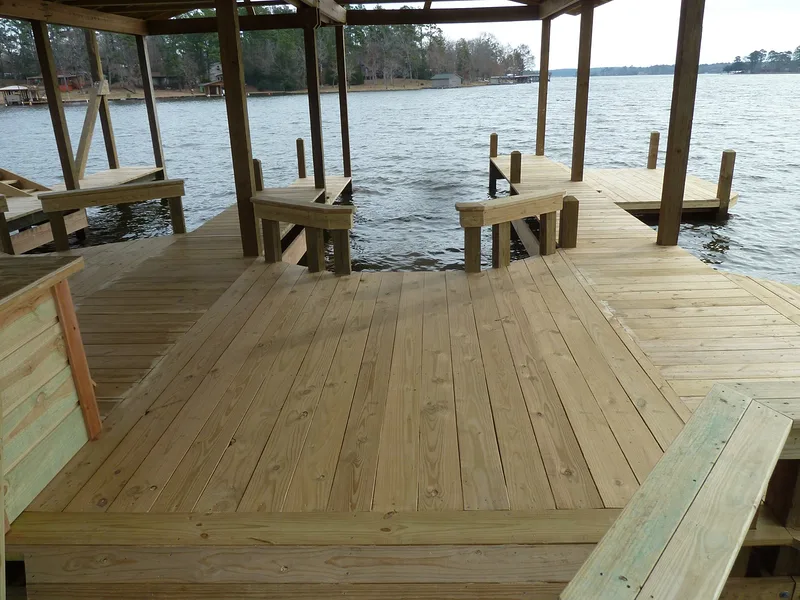
It is a surface that spans between stringers and carries nothing else. ASTM D7032, the standard they are evaluated to, rates them one way: maximum span between supports, and allowable load at that span. Not a beam, not a brace.
Owens Corning's listing rates the 5/4x6 WearDeck board to a 24-inch maximum span. At the L/180 deflection limit the same board is listed at 665 psf over 16-inch centers and 195 psf over 24 — identical plank, and you are buying the spacing. Quote those two against each other and nothing else: they come from DrJ Listing 2311-03, Table 4, at a temperature factor of 1.0. The separate ASTM D7032 span rating in Table 3 — 24 inches at 100 psf — is the figure adjusted for high temperature and freeze-thaw, which is the one that matters in a Texas July.
Our pier drawings set full-dimensional rough-hewn 3x8 stringers on 18-inch centers to suit the Sure-Step panel called out in the note — the spacing follows that product's own support requirement, not WearDeck's board rating. Take it as our framing standard for that panel, not a universal rule: most brands cap straight-laid boards at 16 inches.
The timber carries the load; the composite is what you walk on. Put the same board over a frame that was already marginal and you have added no stiffness at all — the deck still moves as much as the framing lets it, and you may end up replacing framing under a surface that is still sound.
Over water the numbers tighten again — surface temperature underfoot, the span the board is actually rated to, which lines are approved for marine use, and how the fasteners and gapping are set. Composite dock decking is worked through in full on its own page.
Two of our design drawings for a set of public fishing piers, redesigned as a more family-friendly facility — heavy timber frame, composite surface sized to it. Design drawings issued for proposal, not a built record.
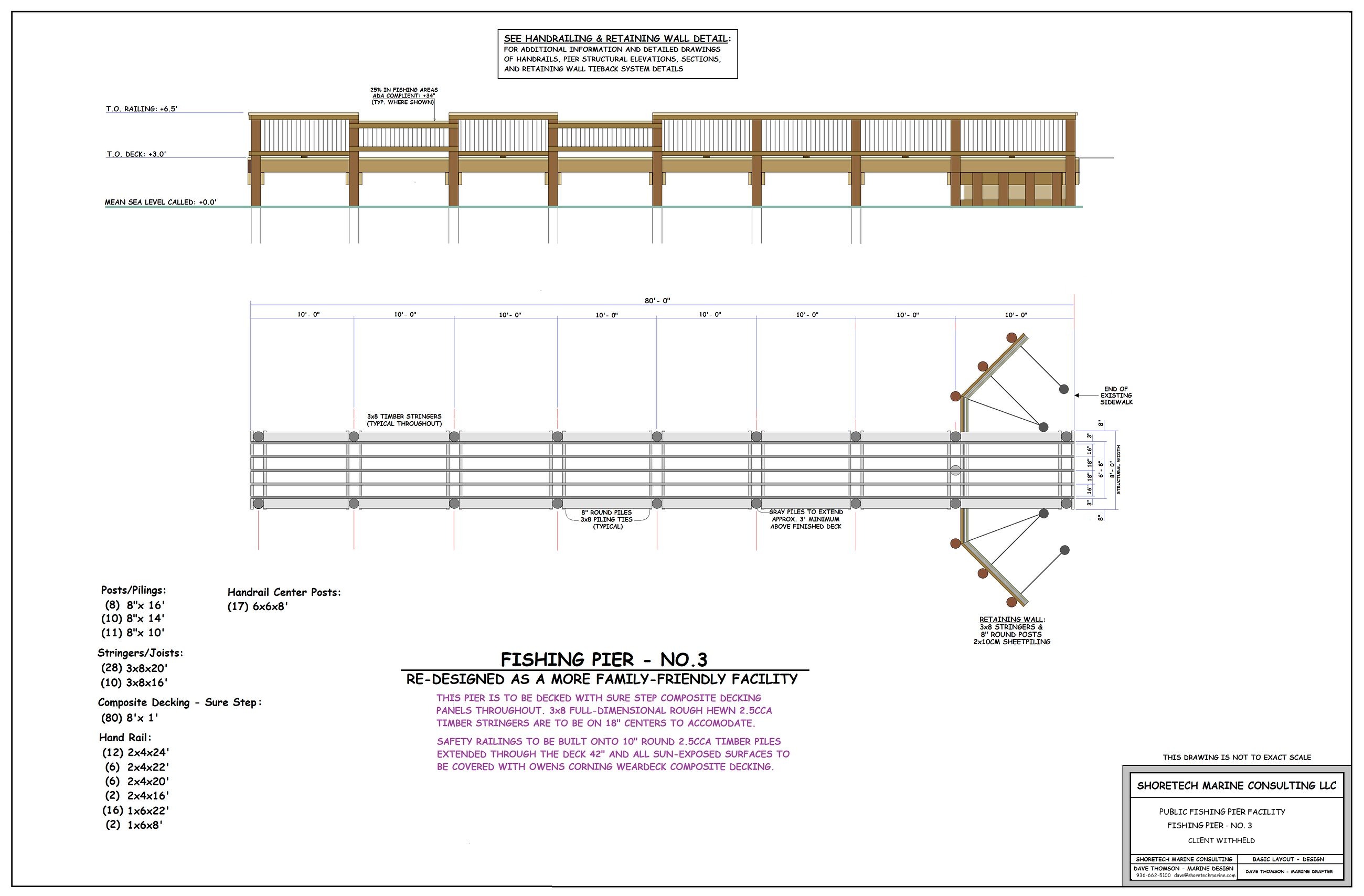
Pier No. 3 — 80 ft long on an 8 ft structural width. Open it at full resolution to read the note and the bill of materials.
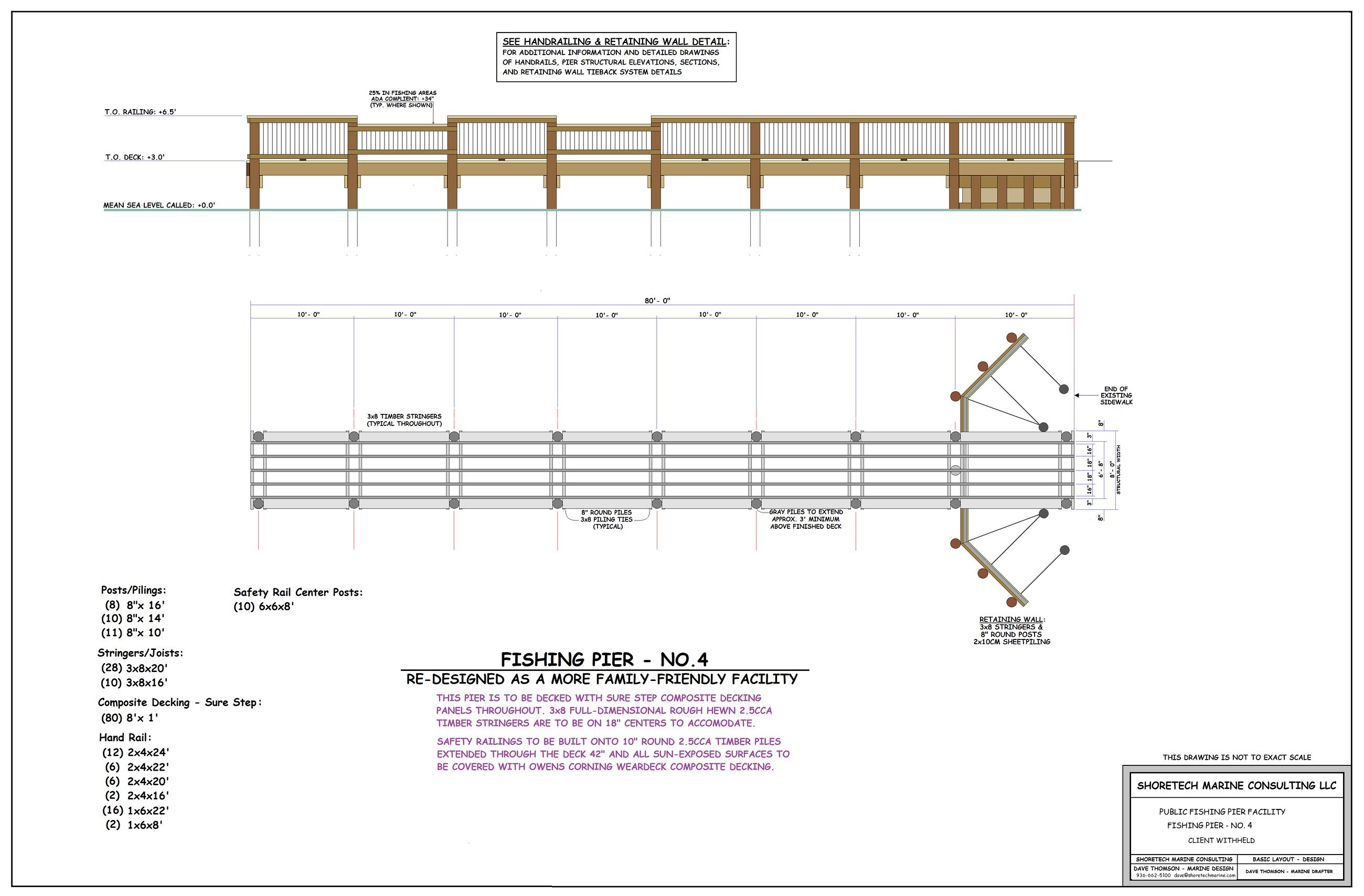
Pier No. 4 — the matched sheet, same construction and same written specification.
The notes carry the whole system: Sure-Step composite panels throughout, 3x8 rough-hewn stringers on 18-inch centers to accommodate them, railings built onto 10-inch round piles carried 42 inches through the deck. Fasteners too — stainless screws and ring-shank nails, hot-dip galvanized bolts and washers. On a deck that lives wet, the hardware schedule is not a detail.
One honest note on treatment. Those piles are specified at 2.5 pcf CCA, and on this site that is the marine retention rather than an over-specification: these sheets are for a tidal, brackish coastal site, and AWPA U1 puts bulkhead and piling work there in the marine use categories. If anything the standard asks for more — in the southern salt and brackish waters of Use Category 5C, where pholads live, the Wood Handbook calls for dual treatment rather than CCA alone. A freshwater lake pier is the opposite case, and gets specified to the ground-contact and freshwater-piling categories instead, which are far lower. Retention is a dose set by exposure, and the exposure is the thing to get right. These are design drawings, not stamped engineering.
Service runs the same lines every night, so wear concentrates. Board direction, spacing and drainage get laid out around where the trays actually go.
Crowd loading is not table-and-chair loading. Framing gets sized for people standing shoulder to shoulder, and detailed so a spill and a rainstorm both leave.
Wet feet, bare feet and constant splash-out. Texture, slope and the transition to coping matter more than anything in a brochure.
Weight, heat and chemicals in one small area, usually where nothing was sized for a stone counter and an appliance run. Designed in, not added later.
Both serve residential and commercial work equally well — on the ground. That qualifier is the whole rule.
Dyed, stamped and printed concrete is a strong answer for a pool surround, a patio or an outdoor kitchen on a properly prepared, compacted subgrade. It takes color and pattern, it shrugs off traffic that would chew a softwood, and there is no annual coating. What it wants in return is to stay still — which makes the sub-base the real work.
Tile is a finish rather than a structure, so the substrate decides everything. Movement cracks tile, and outdoor tile also has to be chosen for how it behaves wet under bare feet.
Neither belongs on a timber pile-supported structure over water unless it was designed for that dead load from the start. Weight and movement both work against you out there, and we would rather say so at the sketch stage than pour it.
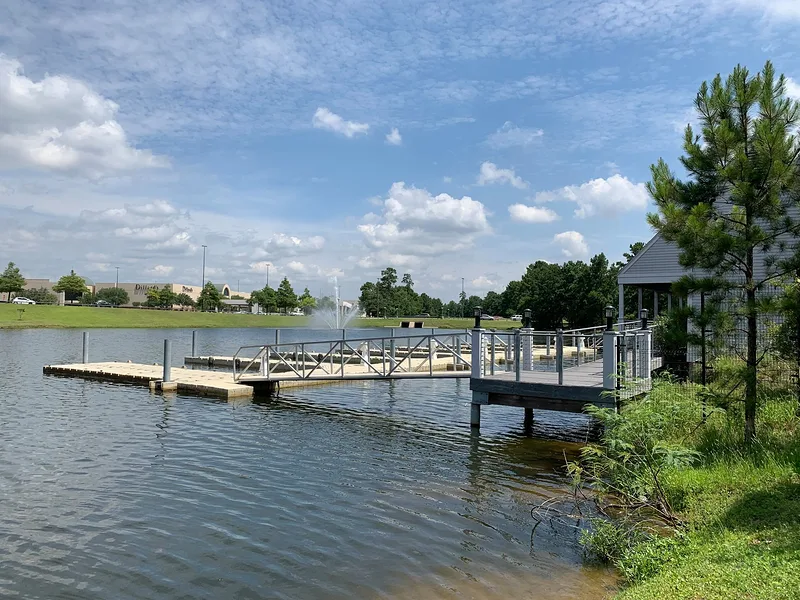

A deck, a walkway down the slope, and a structure over the water get drawn as one project. They are really three, and the seams are where trouble lives.

The material changes. Lumber treated for above-ground use is right on the deck and wrong for a post standing in a lake — different use categories, different retentions — and the changeover falls partway along a walkway.
The water changes. A yard sheds toward the lake, so the joint where a deck meets a walkway is where runoff concentrates. Handled on the drawing it is a detail; handled afterward it is a washed-out approach.
The permission changes. At some elevation the ground stops being yours and starts belonging to a lake authority, a river authority or the Corps, and that line rarely follows the fence.
So we design the transition first. If a walkway ends at a shoreline wall, the wall gets planned with it — and if you are unsure who controls your waterfront, start with who has to approve it.
A boardwalk on posts through marsh grass is a decking job. A crossing that has to clear a creek, a ravine or a flood channel is a bridge, and gets designed as one — piles, spans, approaches, and high water.
Most often it is juvenile wood — the rings nearest the center of a fast-grown pine, which shrink far more along a board's length than mature wood does. That movement opens checks, every check breaches the treated shell, and the crack holds water. A movement problem first, a decay problem second.
Sometimes. We measure joist spacing first, because a composite board is rated by the span it crosses, and a frame built for treated pine at wider centers may not be rated for the board you want. Then we look at the framing and the piles, and tell you which is the real job.
No, and both manufacturers say so in writing. Owens Corning excludes variations in the original color — fading, discoloration and spotting — along with repairs required by normal wear and tear; Perspective Products excludes color fading from normal weathering. What composite removes is the sealing cycle and the splinters.
We will not give you a number. The category is only about thirty years old, and there is no independent long-term field data comparable to the treated-wood stake plots — every figure in circulation traces to a manufacturer or a trade group. What is verifiable is narrower: there is no wood fiber in these boards for a fungus to feed on.
Any deck surface in full July sun gets hot, composite included, and lighter colors run cooler. If that matters — a pool surround, or a pier children run on barefoot — say so early and we will get samples in front of you before the order goes in.
Tell Dave what the deck has to carry, where it starts, and where it has to get to. Photos of the framing help more than photos of the boards.