Galvanized Steel
Highest load capacity, often with coal-tar epoxy for immersed service. Strong where roots, rock, and hard driving challenge lighter systems.

A bulkhead holds back far more than water. Backfill weight, saturated soil, root systems, and storm-driven pressure all push on the back face. Shoretech engineers around the load — across Lake Livingston, Lake Conroe, and waterfronts throughout Texas and Louisiana.
Most bulkhead failures begin out of sight — behind the wall, below the mudline, or in an assumption nobody checked.
If you have been calling it a seawall, you are describing this exact structure. In marine construction and on permits it is called a bulkhead, and it is the wall standing between your yard and the lake — the thing that stops shoreline erosion from taking the property a foot at a time.
A wall can fail not because the face was weak, but because it was never properly tied back, the backfill wasn't understood, the soil pressure was underestimated, or drainage behind the wall was never planned. Water trapped behind a wall is what eventually pushes it over.
Shoretech evaluates the complete condition — water, soil, exposure, backfill, drainage, and corrosion — before choosing a system. On larger or commercial walls, we coordinate with engineering firms for stamped calculations.
A wall that is leaning, opening at the joints, losing yard through a sinkhole behind the cap or rusting through at the waterline is telling you which part of it failed. What each of those symptoms means — and when a wall can be repaired instead of replaced is worked through on its own page.
If you are trying to read your own wall before calling anyone, start with the eight signs a bulkhead is failing. If the top has already rotated toward the water, the direction of the lean narrows it further — that is covered under why a bulkhead leans.
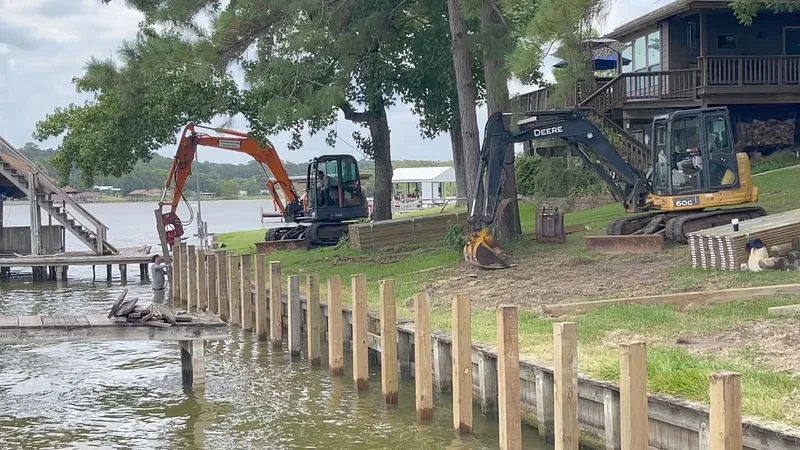

Steel rods anchored to buried deadmen carry the load back into stable ground — spacing set to the wall, not a habit.
Free-draining backfill and a planned drainage path keep hydrostatic pressure from building behind the wall.
Mudline-to-cap height, water depth, fetch, and Texas clay behavior shape the cross-section and embedment.
Fresh water, salt water, soil chemistry, roots, rock, exposure, appearance, budget, and lifespan all change the answer. There is no single best material.
Highest load capacity, often with coal-tar epoxy for immersed service. Strong where roots, rock, and hard driving challenge lighter systems.
Corrosion-immune and long-lived, a common choice for fresh-water residential shorelines where loads allow.
Fiberglass-resin sheet pile — salt-tolerant, dimensionally stable, and strong for demanding environments.
Traditional and repairable when properly treated, properly sized, and properly tied back to the upland.
The U.S. Army Corps of Engineers had stopped permitting shoreline reinforcement on Lake Lewisville after years of walls that failed. Shoretech is currently the only contractor they permit to build bulkheads there — steel or heavy timber — through the end of December 2027. Permitting that exception took a year, and the Corps inspected the finished wall before authorizing anyone.
Galvanized sheet piling on one shoreline, heavy timber on the next — the same wall, matched to the site it has to hold.
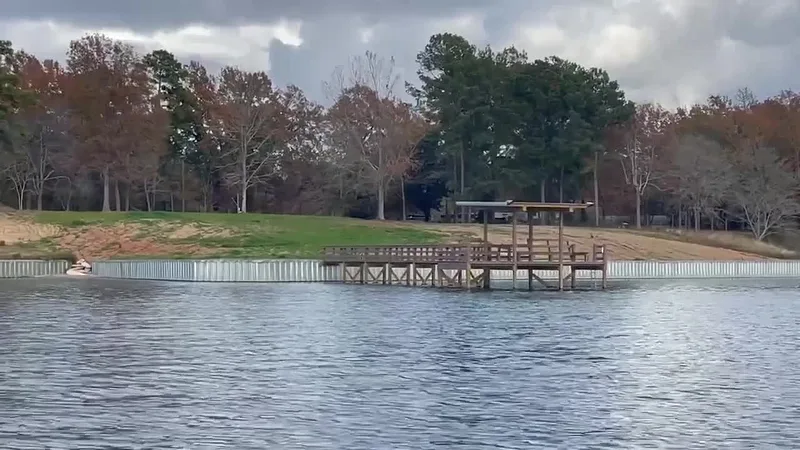


Rods running back from the cap are what stop a wall rotating outward — provided they end past the soil that is already moving.
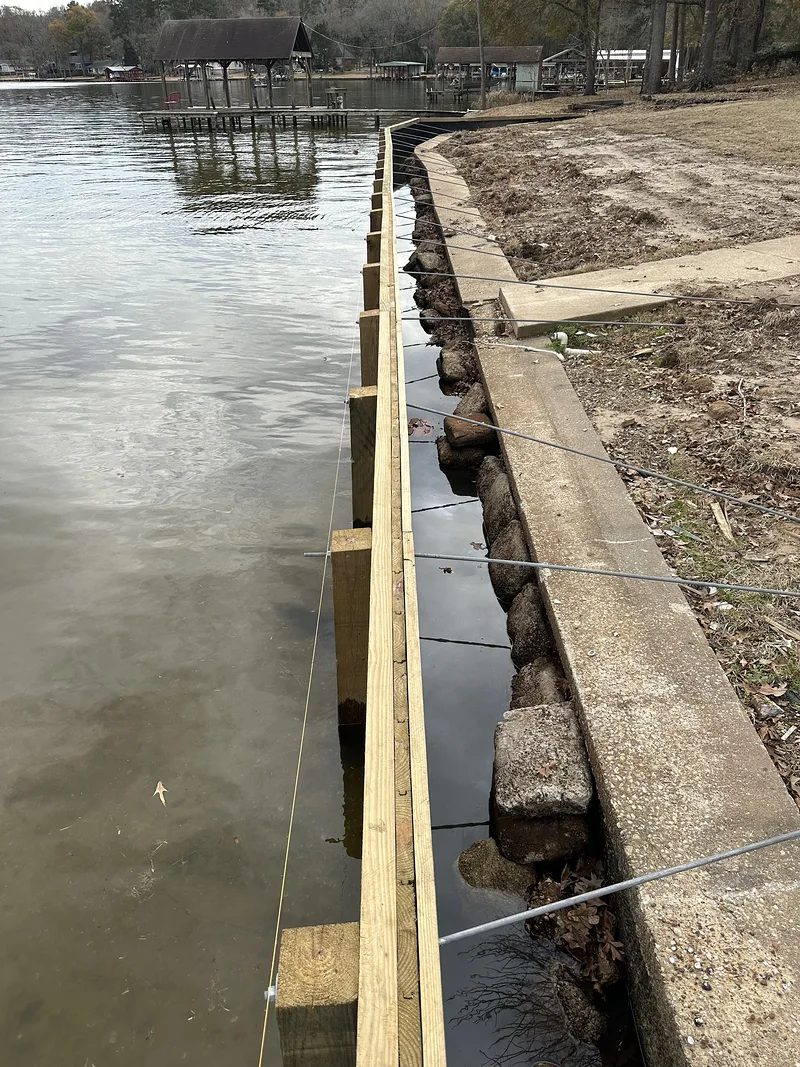
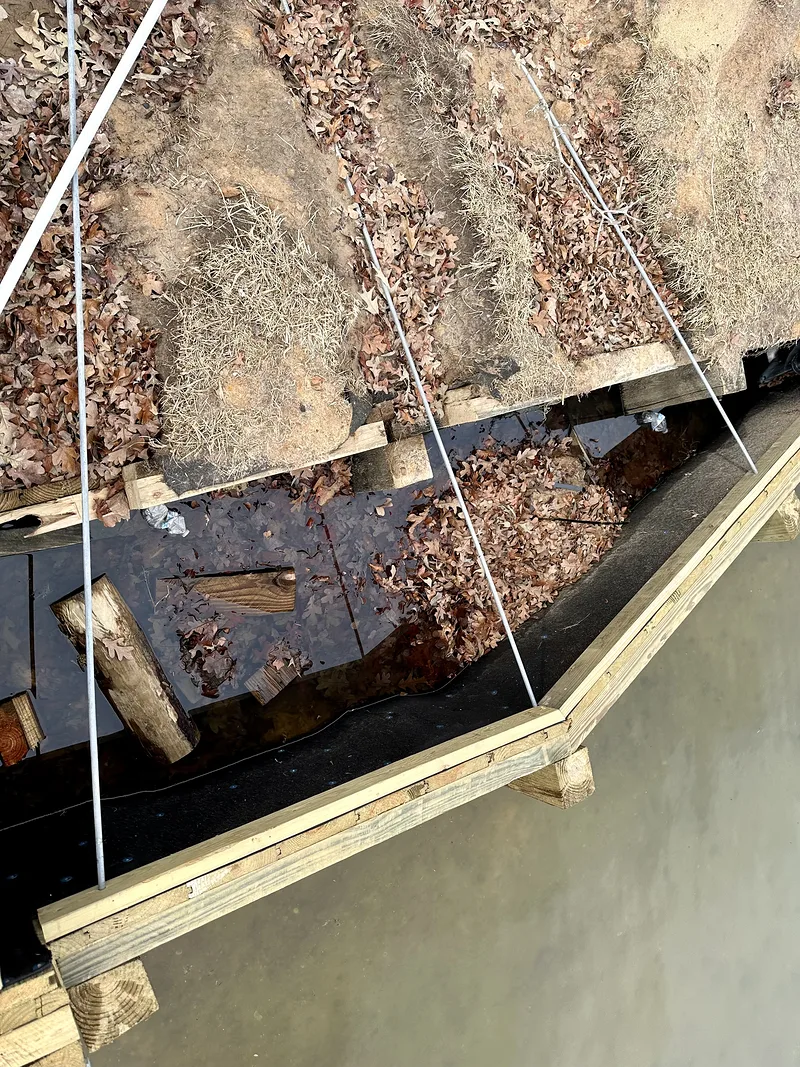
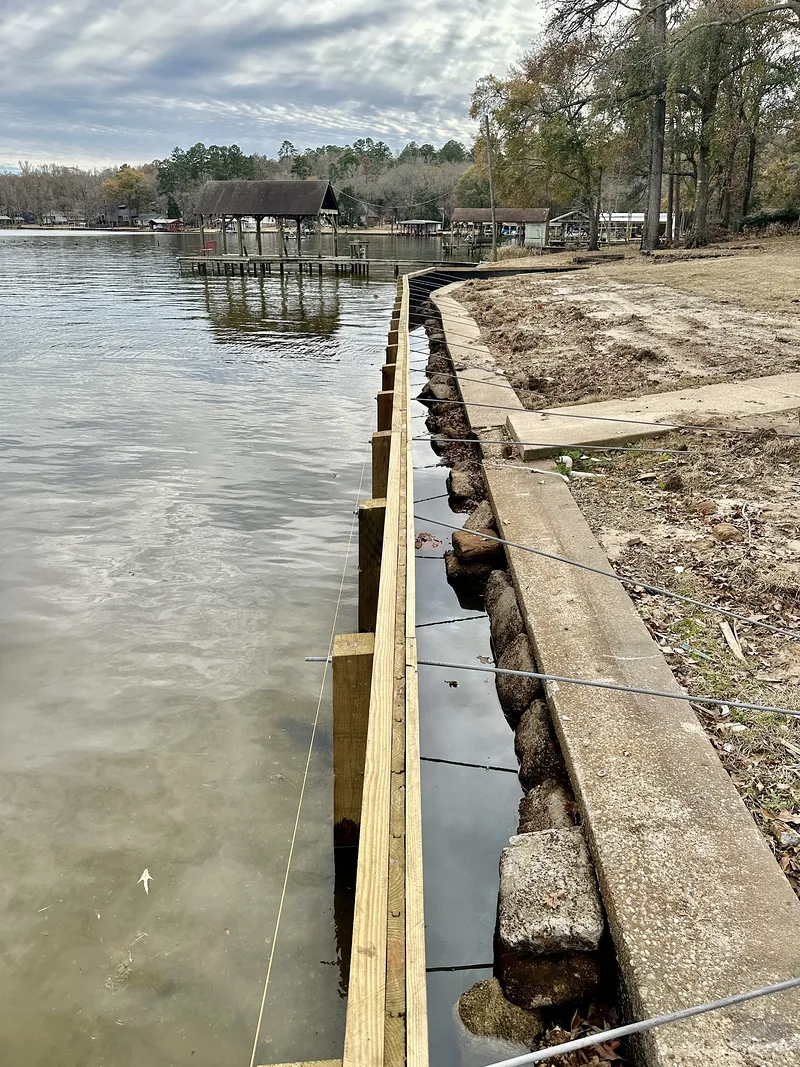
On a replacement like this the new run is driven on the water side of the failed wall, so the bank is never opened up unsupported while the work goes on. The rods carry back over the old structure to anchors set inland, a timber wale spreads their load along the run instead of into single sheets, and filter fabric goes in behind the wall to let water out while keeping your yard where it is.
Rods, wales and filter fabric all vanish the moment the bank is graded back in — so here is the same wall three times: standing with all of it still exposed, the day the fill goes in behind it, and a finished run from the water, the side of a wall an owner almost never gets to stand on.
Everything that holds a tied-back wall up, filmed while it can still be seen: sheeting against the wales, tieback rods running to their deadmen, and the braces keeping the face plumb.
Truck after truck of clay tipped along the back of the wall and spread in behind it. This is the load the tiebacks and deadmen were sized for, and the last anyone sees of them.
Dave's own footage at Cedar Point on Lake Livingston — sheeting set against the wales, posts bolted through with galvanized hardware, and the bank brought back up behind.
Everything above this point is about sheet piling holding a bank back. On a recent private-pond project the same material did a completely different job — a closed rectangle of galvanized sheet piling, roughly 24 by 20 feet, driven as the foundation of a two-level swim deck.

The corrugated steel running the length of the base is the foundation, not a retaining wall — a closed cell, driven and then filled, with the deck and the swing arms built on top of it. A private multi-family freshwater lake, still filling; the waterline is low because the lake has not come up yet. A zip line is planned alongside the swing arms once it does.
An open bulkhead is a cantilever. Soil and water push on one face, and the wall resists by what is buried below the mudline plus tiebacks running to deadmen set back in stable ground. Close that same run into a rectangle and the mechanics invert: nothing pushes the box sideways, because the fill inside pushes outward on all four faces at once. That outward pressure is carried around the perimeter as tension through the interlocks. The mechanism is the same in kind as the one cofferdam cells use — though neither the label nor the product is. A cofferdam is temporary by definition, built to keep water out of a hole so something permanent can be poured dry; this box is permanent and it stays full. And true cellular structures are built from hot-rolled straight-web piling whose interlocks carry a published, guaranteed tensile strength, which cold-formed light-gauge sheet does not. That matters less here than it sounds, because hoop tension scales with the depth of fill, and a cell this shallow generates very little of it.
Which makes the fill the structure, and the steel the membrane that holds it in. How much the box weighs, how stiff it is, and what it can carry are all questions about what went inside. Loose sand is the cheap answer and the wrong one in a closed cell. You cannot get a compactor into the corners of a box, so it never reaches proper density; uncompacted granular fill keeps settling under load for years, which shows up later as a deck that slopes and moves; and fines can migrate out through an interlock gap or a leak at the toe until there is a void under the deck that nobody can see from above.
What went in instead was a stabilized mix — sand blended with cement and a plasticized mortar, proportioned in advance and mixed to flow rather than to be compacted, so it fills the corners and the space under the deck frame by running into them. It is honest to call that fill and dishonest to call it concrete: it is not a footing, not a slab, and not a structural pour. A self-compacting cemented fill in the 50 to 100 psi range gives roughly the allowable bearing pressure of a well-compacted fill — which is precisely the performance you cannot get with a plate compactor inside a closed cell. It also cannot be poured through standing water, because the cement washes straight out of the mix, so a cell like this gets filled dry. Worth noting too: a cemented fill is far less permeable than the free-draining granular fill a conventional cell assumes, so a relief path out of the box deserves the same thought this page gives drainage behind any other wall.
The reinforcement in that fill is composite bar, not steel. Concrete protects steel chemically rather than physically. Fresh concrete pore water is strongly alkaline, and at that alkalinity a passive oxide film only a few nanometres thick forms on the bar and holds corrosion off. Steel in concrete is not safe because it is covered up; it is safe because it is sitting in a chemical bath. Chlorides working in through the cover break that film in spots, and once rust starts it does the real damage: corrosion product occupies roughly two to six times the volume of the steel it consumed, and locked inside hard concrete it works like a slow jack — the cover cracks, delaminates, and sheets off, exposing more bar to finish the job. Glass-fibre composite bar has no iron in it. There is no corrosion cell to start and no expanding rust to split the fill apart from the inside.
That is a real advantage and it is not a free one. Composite bar is not a drop-in substitute for steel: its stiffness is about a quarter of steel's, so members get sized by deflection and crack width rather than by strength, and the usual result is more bar and more section, not less. It cannot be bent on site — the resin cures once, at the factory, so every hook and bend has to be ordered made, and a factory bend is meaningfully weaker than the straight bar. "Composite rebar" is also not a regulated term; the certification worth asking any contractor for is ASTM D7957. As for how long it lasts: bars cut out of 15- to 20-year-old bridge decks show very little measurable loss, which is genuinely good evidence and is not the same thing as a century of proof. Nobody has that yet.
The gate and the ramped-down side of the deck land on thick-wall drill-stem pipe piles welded to angle iron — surplus oilfield pipe, used here for the reason marine contractors use it everywhere on this coast. Thick wall means a large corrosion allowance, not steel that resists corrosion; high-grade pipe rusts at much the same rate as ordinary structural steel in the same water. It simply starts with far more metal to lose. Everything above the fill line — the framing, the stair, the railings, the upper level — is the same deck and pier work Shoretech builds on any shoreline.
Dave's own description of that piling is "hot-dip galvanized 5 gauge steel coated thick enough to call it a forever structure." That is his phrase, and it is worth unpacking rather than repeating.
Batch hot-dip galvanizing to ASTM A123 dips the finished piece in molten zinc after it is fabricated, so cut ends, welds and interlock faces are all coated. Mill-galvanized coil to ASTM A653 is coated flat before the sheet is formed and cut — roughly half the zinc per side, and every cut edge left bare. Shoretech specifies the batch-galvanized A123 product. It is the dearer of the two and it is worth asking any contractor which one their quote is built on.
Five gauge sheet steel is 0.209 in, a shade over 3/16 and the heaviest section in the light-gauge family. For steel in that band A123 sets a minimum of Grade 85 — the grade on this work — 85 microns, 3.3 mils, 2 oz per square foot. Those are minimums with no ceiling, so real coatings often run thicker.
The buried portion, the permanently submerged portion and the splash line all age at different rates. The splash zone is usually the shortest-lived of the three, because wetting, drying, full oxygen and mechanical abrasion all arrive in the same band of steel.
The familiar galvanizing service-life chart — the one that produces headline numbers like seventy or ninety years — covers five atmospheric exposures, and the body that publishes it states plainly that it does not apply to coating life in soil or water. There is no equivalent chart for fresh water at all, because fresh water varies too much to have one. Published zinc loss rates in fresh water run from about half a mil to eight mils a year depending on hardness, pH, dissolved oxygen, temperature and how much the water moves. Hard, still water lays down a carbonate scale that armours the zinc; soft water and moving water strip it off. That is a sixteen-fold spread, and anyone quoting a single service-life number for a specific pond without testing that pond's water is guessing. It is also worth knowing that "time to first maintenance" on those charts means the point at which about five percent of the steel surface shows rust — the touch-up point, not the end of the structure.
So the honest version of Dave's sentence is narrower than the word forever and still worth having. Zinc corrodes at roughly a thirtieth the rate of bare steel in the same environment, which buys a long head start rather than immunity. A heavy section starts with a large allowance before section loss means anything structurally. Composite reinforcement removes the failure mode — rusting bar splitting the fill apart from within — that ends most waterfront concrete. And still, sheltered fresh water is one of the kinder places on earth to put steel — and where that water is hard, the carbonate scale armours the zinc on top of everything above. Light-gauge piling is the right product for a private pond and the wrong one for an exposed reservoir shoreline, which is the same point this page makes about every other material on it. The reasoning carries straight across to bolts, brackets and every other buried detail that decides how long a structure really stands.
It is also why the guarantee splits the way it does. On private ponds and small lakes it can extend to 10 years, because we only use the best building techniques and materials available.
Yes — same structure, two names. "Seawall" is what most property owners say; "bulkhead" is the term used in marine construction and on permits. Whichever you call it, Shoretech builds it in galvanized steel, vinyl, FRP composite, or heavy timber.
Whichever matches your water, soil, exposure, and budget. We'll walk the shoreline and recommend the system that lasts, not the one that's easiest to sell.
Usually tiebacks, backfill, or drainage — not the face. We diagnose the cause before rebuilding so the replacement doesn't repeat it.
It depends on what actually failed. The front face and the anchor system behind it are separate parts of the wall, and one can outlast the other — so we look at both before assuming the whole thing has to come out.
Often, yes — dredged material can sometimes be pumped behind the new wall as backfill, raising usable property while restoring water depth.
Yes, Lake Livingston is core to our service area, along with Lake Conroe, Sam Rayburn, and most waterfronts within about 120 miles of Huntsville.
Yes. On large Texas and Louisiana lakes and reservoirs — Livingston, Rayburn, Conroe — and along the Gulf Coast, our guarantee typically runs 2 to 5 years depending on the project. On private ponds and small lakes it can extend to 10 years, because we only use the best building techniques and materials available.
Yes. Driven as a closed cell instead of an open run, sheet piling stops working as a cantilever holding a bank back and becomes a confined box — the fill inside carries the load, and the steel holds the fill in. We have used one that way as the foundation of a two-level swim deck on a private freshwater lake, filled with a stabilized cement-and-sand mix around composite reinforcing bar rather than loose backfill. Same material, different job, and it suits small sheltered water better than an exposed reservoir shoreline.
Soil, exposure, fetch, and how far the lake draws down all change which system belongs on a shoreline. Each lake below has its own page.
Send photos and describe the soil, water, and exposure. Dave can tell you what's really going on behind the wall.