
Tell us about the water.
Call Dave directly, or send the details below. Either way the first conversation is with the owner — the same person who walks your shoreline and stands behind what gets built on it.
Five things that make the first reply useful.
None of it is required. It is what turns a general answer into a specific one.
Where the property is, precisely
Lake, subdivision and county. Which body controls the water in front of your lot changes what can be built and how it is authorized, so it gets settled first. Unsure who governs your frontage? Start here.
What the water does through the year
How far it drops in a dry summer, how much bottom shows at low pool, whether wake off a channel works the bank. A structure is designed around the worst week of the year, not the day you are standing there.
What is already there, and roughly how old
An existing wall, dock, boathouse or lift changes the approach — what can be kept, what comes out, and whether new work ties into something built to a different standard.
What you want it to do, not what to call it
A slip for one boat and a slip that seats twelve for dinner are different structures on different substructures. So are a wall holding a lawn and one holding a driveway.
Any deadline you did not choose
A closing date, a board meeting, an authorization about to expire. Mention those early: authorization is usually the longest item on the calendar and the one nobody can compress.
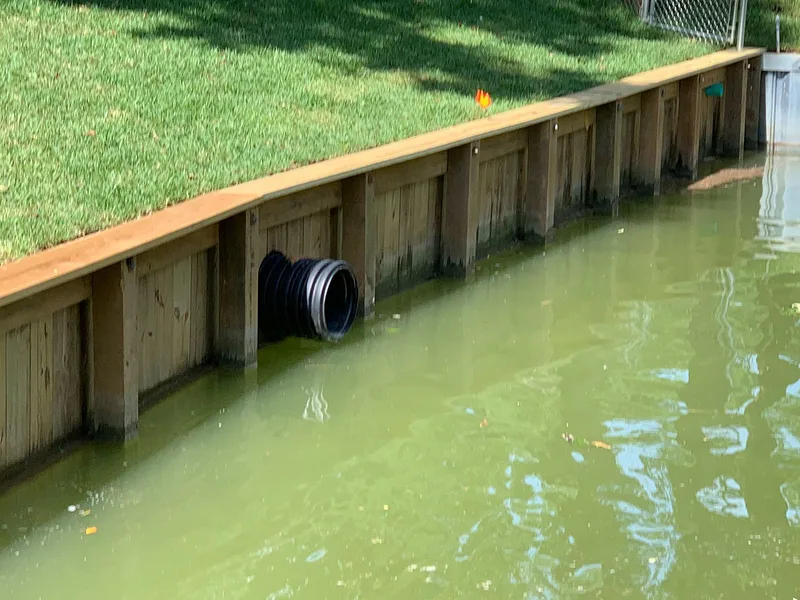
The joints and the top of the wall say more than any description.
Owners describe a wall as leaning. A photograph says by how much, in which direction, and whether the part that failed is the part you are looking at.
Sight down a cap from one end and a lean shows up in a way it never does from the middle of the lawn. A close-up of a joint says whether it is a gap that opened or a plank that split — two causes, two different repairs. The top of the wall shows whether the cap has merely weathered or has moved off the line of the structure beneath it, which is the difference between a tidy afternoon and a structural job.
Take them at low water if you can, and note the date. What gets read is often not one photograph but the change between two taken months apart — which is why the best time to send a first set is before anything looks urgent.
From the first call to a scope you can read.
Nothing is priced before the third step, because until then a number is a guess dressed up as a quote.
The conversation
Dave asks about the water before the budget. Most calls settle three things: what is wrong or wanted, whether it is urgent, and who controls the shoreline. Some end there, with a reason to wait.
Photographs, and whatever is in your file
Your images, plus any plat, survey, prior authorization or old drawing — enough to know whether this needs an hour on the bank or a day with equipment.
The site visit
Dave comes to the property himself. It is the step that turns a description into a scope, and it is set out below.
A written scope, then authorization
What is being built, in what material, on what substructure — and what has been left out. Then the authorization route for your water, which on most lakes sets the start date rather than the crew calendar.
An hour or two on the bank decides most of it.
A waterfront project is settled by things no photograph shows: what the bottom is made of, whether the bank behind a wall is solid or quietly hollowing out, how far back the old anchors sit, and what a machine or a barge can reach.
So it is deliberately physical. Depth read at several points rather than one. A probe into the backfill for voids. A blade into the timber at the waterline, because freshwater structures fail from the inside and can look sound while hollow. Then the access route, and drainage last. Bring anything you have on paper, and the neighbour's account too.
Getting in touch, answered.
What is the fastest way to reach Dave?
The phone, 936-662-5100. It rings the owner rather than a scheduler, so the first person you describe the shoreline to is the one who will stand on it. If he cannot pick up, leave the lake and a callback number. The form here and Dave@shoretechmarine.com reach the same inbox; email is better when you have photographs to attach.
What should I photograph before I call?
One shot down the length of the structure from each end, so the line of it reads. Then close-ups of the joints, the top of the wall or cap, the waterline band, and any fastener that is staining. Low water is the best day of the year to do it, and note the date.
How far will Dave travel for a project?
Shoretech is based in Trinity, Texas, and the closest work is on Lake Livingston. Beyond that Dave travels as far as the project warrants, across Texas and into western Louisiana. Distance is a scheduling question rather than a yes-or-no one, so ask about your water.
Why will you not quote a boathouse or a bulkhead over the phone?
Because the half of the job that sets the price is the half you cannot photograph: what the bottom will hold, how far back the anchors sit, and how much soil has already left. Our guarantee typically runs 2 to 5 years on the large Texas and Louisiana lakes and up to 10 years on private ponds and small lakes, with the terms set out in your agreement for the job.
We are an HOA, POA, marina or municipality. Who should make the first call?
Whoever can walk the site and answer questions about it. Boards often send the person holding the budget, but the more useful first conversation is with whoever watches the water. Say when your decision meeting is and the visit can be scheduled ahead of it.
Three pages worth reading first.
Call Dave, or send the photographs.
Either one reaches the owner. The phone is faster, the photographs are more useful, and together they usually mean the site visit has a purpose before anyone arrives. Based in Trinity, building waterfronts for more than 40 years — over 250 boathouses and 850-plus projects.