
Built to still be there on Monday morning.
After a major storm the first thing Dave does is put a boat in the water and go look at what he has built. This page is about what he is looking at, and how to check the structure you already own.
The first thing Dave does is take a boat ride.
It isn't sentiment. A storm is the only honest report card a marine builder ever gets, and he goes looking for it.
When a hurricane or a major storm comes through, Dave gets on the water as soon as it is safe and runs the shoreline past his own work. What he finds there is his account to give, so take it as his: his boathouses and his bulkheads have come through storms that left other structures broken up on the water, and he has watched that hold across forty years.
Read that as exactly what it is — one builder's testimony about his own structures. Nobody counted, and no builder, Dave included, can promise that a particular structure will survive a particular storm. Every structure has a load beyond which it fails. What can be accounted for is why the two groups behave differently, and it comes down to decisions made before anything was cut.
A great deal of the boathouse work on Texas lakes is done by good carpenters who moved out onto the water. This is not about the people or their care — it is about which forces got counted. A house is designed to be pushed down by gravity. A boathouse spends its life being pulled up. Borrow the habits from one for the other and the result stands for years, looks perfectly sound, and has almost no reserve left when the wind doubles. The photographs below are of our own work, taken mid-build, because once the roof is on nobody can see the part that decides the outcome.
It rarely starts with a broken timber.
The classic post-storm photograph is a boathouse lying over at thirty degrees with every member intact and not one of them snapped.
Two ideas explain a great deal of the damage on these lakes, and neither is intuitive. Wind pressure rises with the square of the wind speed — a gust front stepping from 90 mph to 130 mph delivers not forty percent more load but roughly twice as much, which is why "it has stood for ten years" proves so little. And open water is the worst wind exposure there is: ASCE 7 puts water surfaces in its roughest-wind category, because nothing out there slows the air down.
Uplift on an open roof
Wind flowing under an open-sided roof pushes up on the underside at the same moment flow across the top pulls up. The two add rather than cancel, which is why ASCE 7 gives free roofs their own net pressure coefficients. The assumption that open sides let the wind through is backwards for the roof.
Racking of the frame
Four members with pinned corners fold into a parallelogram without one of them changing length. It is geometry, not strength, so heavier posts do not fix it. In an open frame like this, triangulation is what does. An unbraced frame leans further under every hour of sustained wind until it has leaned far enough that the roof's own weight starts pushing it over.
Connections loaded backwards
Most timber joints are made for gravity, where wood bears on wood and the fastener does very little. Reverse the direction and the fastener is the connection. Testing with real wind records shows toe-nailed connections ratcheting out incrementally, so a frame can come through a storm measurably weaker with nothing visible to show it.
Water, not wind
When the lake rises over the deck, buoyancy pulls the whole structure upward. The marina guidance hosted by NOAA names one version exactly: pile caps spiked onto piles disconnect when submerged. The related case is a floating dock whose guide piles are not long enough for the rise — at Cassels-Boykin Park on Sam Rayburn in February 2019, local reporting had the public fishing dock floating off its poles at about ten feet of high water.
None of that is theoretical here. In Rita the National Hurricane Center's report lists a 102-knot gust — 117 mph — at Lake Livingston, an unofficial station, and the state floodplain association's post-storm report describes waves estimated near six feet on Lake Conroe cutting a 3,000-foot gash across the face of the dam; in Beryl the National Weather Service measured 81 mph at Montgomery County Airport, minutes from Lake Conroe. Harvey was the other kind entirely: not wind here, but record pool and a record release above 70,000 cubic feet per second at Lake Conroe.

The decisions all get made before anything is cut.
Not a slogan — a load path worked out first, then detailed so every link in it can carry tension.
Start with the honest limit. We do not publish a wind rating, and you should be wary of any builder who quotes one without saying what it was checked against. What we claim is narrower and checkable: the load path is drawn out before the first timber is cut — roof panel to rafter to beam to post to pile to lake bed — and every joint along it is detailed for tension, not only bearing.
That is why the primary frame connections are through-bolted. A machine bolt passes through the whole assembly and is captured by a nut on the far side, so it transfers load by steel bearing against wood and cannot withdraw the way a nail does. The washers are structural, not decorative: in a joint loaded in tension the capacity is usually set by the wood crushing under the washer. Nails hold by a friction that shrinking, checking timber relaxes, and FEMA's coastal guidance states flatly that toe-nailing is not acceptable for resisting uplift in high-wind regions.
The hardware choice is chemical rather than structural. Since 2003 residential treated lumber has used alkaline copper preservatives — ACQ and copper azole — carrying far more copper than the CCA they replaced, and copper against steel in wet wood drives the steel to corrode. Retention is highest in heavy timbers, so it is worst where it matters most. Hot-dip galvanizing answers that with thickness: an ASTM A153 Class C bolt coating runs about 2.1 mils, roughly ten times electroplated zinc.
We will not oversell it. Hot-dip is not the top tier — stainless is, and published guidance recommends stainless for timber that stays wet, giving a lake dock as the example. Zinc is sacrificial and it is consumed. Hot-dip is the minimum the fastener and preservative industries specify for copper-treated lumber, and it is a specification a great deal of waterfront hardware does not meet.

Three things a photograph can actually prove.
Most of what a builder claims cannot be checked from the bank. These three can — on our work or anybody else's — though the third wants a close-up rather than a distant view.
Bolts through, nuts on the far side
At the beam-to-post joint, a post captured between twin beams with three bolts passing through the whole sandwich. Three rather than one matters: a single bolt is a hinge, two make a couple, three leave something in reserve.
Braces in more than one plane
Wind does not arrive perpendicular to a wall by arrangement, and a corner post belongs to two wall planes at once. Four braces triangulate both, in both directions. That does not make the frame four times stronger — bracing does not scale that way — but it converts a collapse of shape into a problem hardware can be sized for.
Dull grey hardware, not bright
Hot-dip galvanizing often looks matte and slightly rough, where electroplated zinc is usually bright and even — and in copper-treated timber, electroplated zinc is on a countdown from the day it goes in. This is the one of the three you cannot settle from a passing boat: finishes vary, so it wants a close look, and if you are unsure, ask what standard the hardware was bought to.
The part nobody sees once the roof goes on.
Load path, lateral bracing, and the most demanding single connection in the building — the one carrying the boat lift.


The wall you can see, and the anchors you cannot.
Almost everyone pictures the lake pushing on the wall. The lake is helping.
A bulkhead is a retaining wall standing in water, and it carries three load families: active earth pressure from the soil behind it, surcharge from whatever sits on that ground, and net water pressure from the difference in head across it. The water term is often the largest, and the one owners never anticipate, because it is not the lake — it is groundwater trapped behind the wall with nothing on the far side to balance it.
A wall with no restraint near the top rotates about a point down inside its embedment, so the cap moves most, and every inch it leans lets soil settle in behind and push harder. A tie-back rod changes that: load is shared between passive resistance at the toe and the rod at the cap, and the bending moment drops sharply. What decides whether the rod is worth anything is where it ends. Soil behind a wall fails along a wedge, and the Corps of Engineers' design manual puts the anchorage fully outside that zone — an anchor set inside it is fastened to the block of dirt the wall is trying to hold.
Weep holes let trapped water out; geotextile filter fabric lets water through while holding soil particles back. Neither works alone. Drainage without filtration is a soil pump, carrying fines out through the joints until voids form and the lawn shows depressions. Filtration without drainage is a dam, and the wall bows. Fabric behind a bulkhead is not waterproofing — passing water is its entire job.
One more catches owners out completely: on a reservoir the worst case is often rapid drawdown rather than the storm. When the lake falls faster than the ground behind the wall can drain, the outside support disappears while the pressure inside stays high. Walls bow and banks slide on a calm afternoon days after the weather cleared.
What rusts, and what cannot.
The same argument as the hardware, in a different material. Corrosion de-rates a structure while nothing about it looks any different from the bank.
Steel reinforcement inside concrete is the purest example of it, because there is nothing at all to see until the concrete itself is coming apart. Concrete does not protect a reinforcing bar by covering it up. Fresh concrete holds water in its pores that is strongly alkaline, roughly pH 12.5 to 13.9, and at that alkalinity a passive film of iron oxide forms on the steel — measured at only about five to thirteen nanometres thick — which effectively stops the bar corroding. The steel is not safe because it is buried. It is safe because it is sitting in a chemistry that keeps it passive, and everything that goes wrong afterwards is the story of that chemistry being lost.
In water, chloride is usually what takes it away. Chloride ions migrate in through the concrete and break the passive film down in small patches rather than across the whole bar, so a bar can lose a great deal of section in one spot while looking sound an inch either side of it. The Federal Highway Administration has used 0.20 percent total chloride by weight of cement as a level that can initiate corrosion in bridge decks, and that threshold is not a fixed number: measured values fall roughly fortyfold between pH 13.9 and pH 12.5, so chloride and lost alkalinity compound each other. Carbonation, where carbon dioxide from the air slowly neutralizes the concrete, is the mechanism that governs concrete standing in air rather than concrete that stays wet, because carbon dioxide diffuses very slowly through water-filled pores. On a structure in the lake it is chloride ingress and the oxygen available at the waterline that decide the outcome.
The expansion is the failure, not the rust
Iron oxide is far less dense than the steel it came from, occupying something like two to six times the volume consumed. Locked inside hard concrete, that expansion has nowhere to go, so it puts the cover into tension — and concrete is weak in tension. It cracks, then delaminates, then comes off in sheets. The loss is double: the bar has less section than it had, and the cover that was protecting it is now on the ground.
Composite reinforcement removes the mechanism
Glass fibre reinforced polymer bar is glass fibre bundles held in a cured thermoset resin. There is no iron in it, so the electrochemical cell that destroys steel rebar has no anode to work with. It cannot rust, and because it cannot rust it cannot generate expansive corrosion product, which means it cannot split the concrete off from the inside. That is the whole claim and it is enough of one. It is not a claim that the material is inert.
Galvanizing delays it on the steel that has to stay steel
Piling, tie-back rods and bolts are still steel, and there zinc is the answer. A galvanized coating is sacrificial: it corrodes in preference to the steel underneath, at something on the order of a thirtieth of the rate of bare steel in the same environment, and it is consumed doing it. That is a real extension and a finite one. A wall standing in water has three exposure zones on the same sheet — buried, permanently submerged, and the splash and waterline band, which is normally the worst of the three.
Composite bar is not a drop-in substitute for steel, and we would not have anyone believe it is. Its stiffness is the catch: the minimum tensile modulus in ASTM D7957 is 6,500 ksi against 29,000 ksi for steel, and the ACI commentary puts it as low as one quarter of steel's. Stiffness rather than strength is what controls how far a member deflects and how wide its cracks open, so composite-reinforced members are governed by serviceability instead of ultimate strength and generally have to be made larger — in one published side-by-side design of the same beam to the same loads, the composite version needed 75 percent more reinforcement area and 70 percent more concrete volume than the Grade 60 steel one. It also cannot be bent on site, because the resin cures once and irreversibly; every bend is made at the factory before cure, and a bend is allowed to retain as little as 60 percent of the straight bar's guaranteed tensile force, which the designer has to account for. And the design codes derate it for wet ground regardless of the fact that it does not corrode: ACI 440.1R applies an environmental reduction factor of 0.7 to guaranteed tensile strength for concrete exposed to earth and weather. One more thing worth knowing before anybody buys any: "composite rebar" is not a regulated term. Only bar carrying mill certification to ASTM D7957 has actually been through the qualification tests.
The durability evidence deserves to be stated exactly as it is, because it is good and it does not need help. Bars extracted from eleven bridges in the United States after fifteen to twenty years in service, including structures exposed to freeze-thaw cycling and de-icing salts, showed damage described as extremely limited — one reported figure is a tensile strength reduction of 4.2 percent after seventeen years. Structures are now being designed for hundred-year service lives on the strength of that. Designed for, not demonstrated over: nobody anywhere has a hundred years of field data on this material, because it has not been in structures that long, and we are not going to write a number we cannot stand behind.
The same discipline applies to the galvanizing. The American Galvanizers Association publishes a service-life chart for atmospheric exposure and another for soil, and states plainly that the atmospheric chart does not apply to coating life in soil or water. For fresh water immersion it publishes no equivalent chart at all, and says outright that zinc performance in fresh water is especially difficult to predict, because small differences in the water produce large differences in corrosion rate. The published rate ranges bear that out: roughly 0.5 to 8 mils per year depending on hardness, pH, dissolved oxygen, temperature and how much the water moves. That is a sixteenfold spread. Anyone who quotes a single service life for galvanized steel in a particular pond, without having tested that pond's water, is guessing at it.
All of which is why the private pond project Dave has in the water right now is built the way it is. The foundation of the pier is a closed rectangle of galvanized sheet piling holding a stabilized sand and mortar mix around a composite reinforcement bar framework — no steel rebar anywhere inside it. Dave's own description is that the coating is thick enough to call it a forever structure. Those are his words and we will leave them as his. What we will put in our own voice is narrower and checkable: taking the steel out of the fill removes the failure mode that ends most reinforced concrete in water, and removes it permanently, because there is nothing in the bar left to rust. Galvanizing on the piling is a delay rather than a removal, and the delay is real but it is spent as it works. Neither of those is a claim that the structure is permanent, and it is not an accident that the guarantee is longest on exactly this kind of water.
You do not demolish the thing holding the bank up.
New sheeting driven outboard of the old wall, tie-backs carried over it to anchors set inland, and filter fabric laid before the cap goes on.
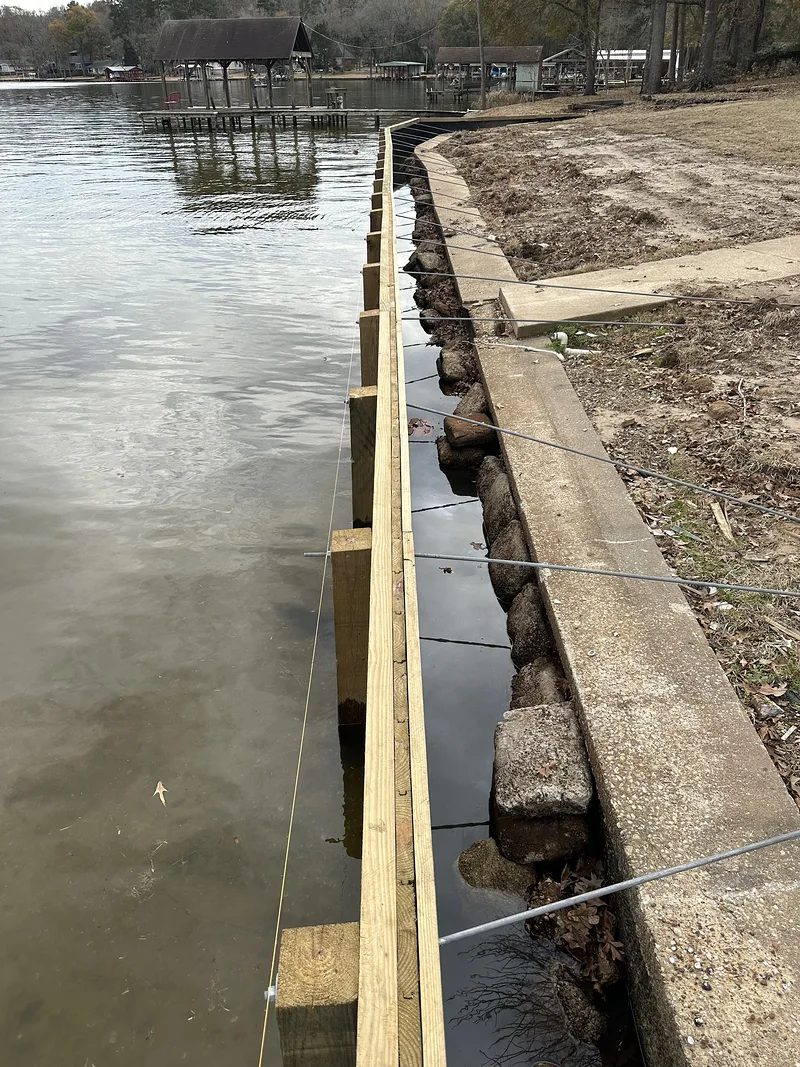
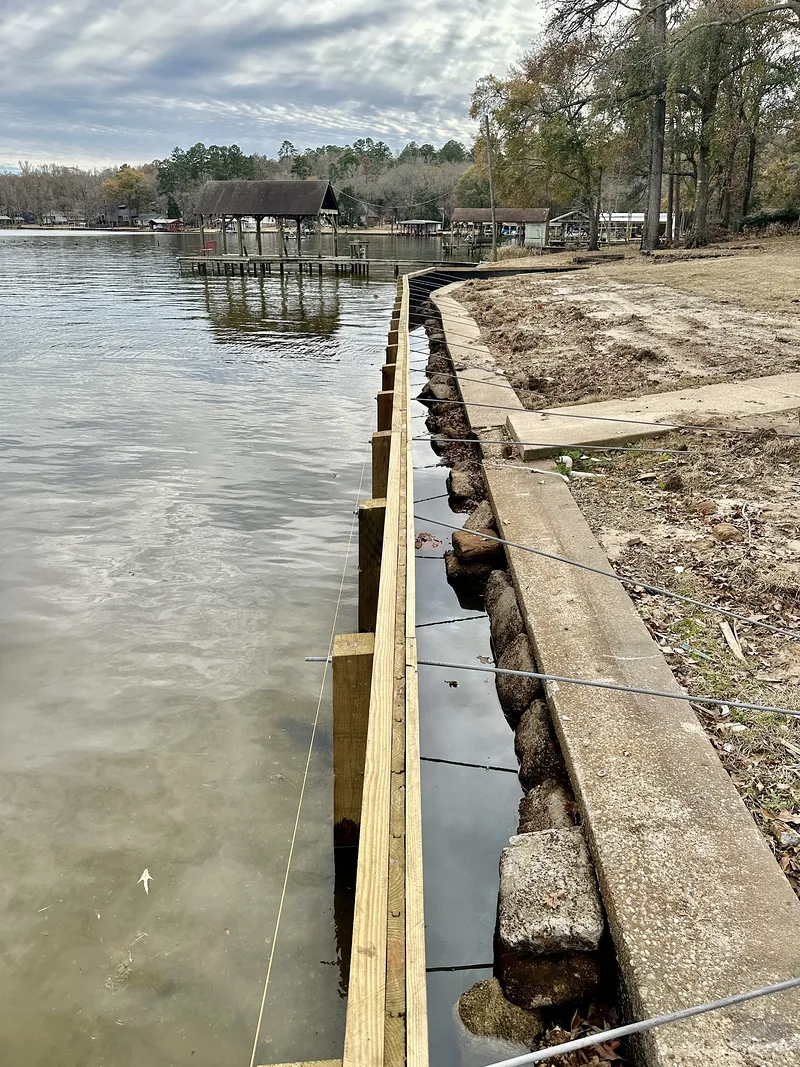
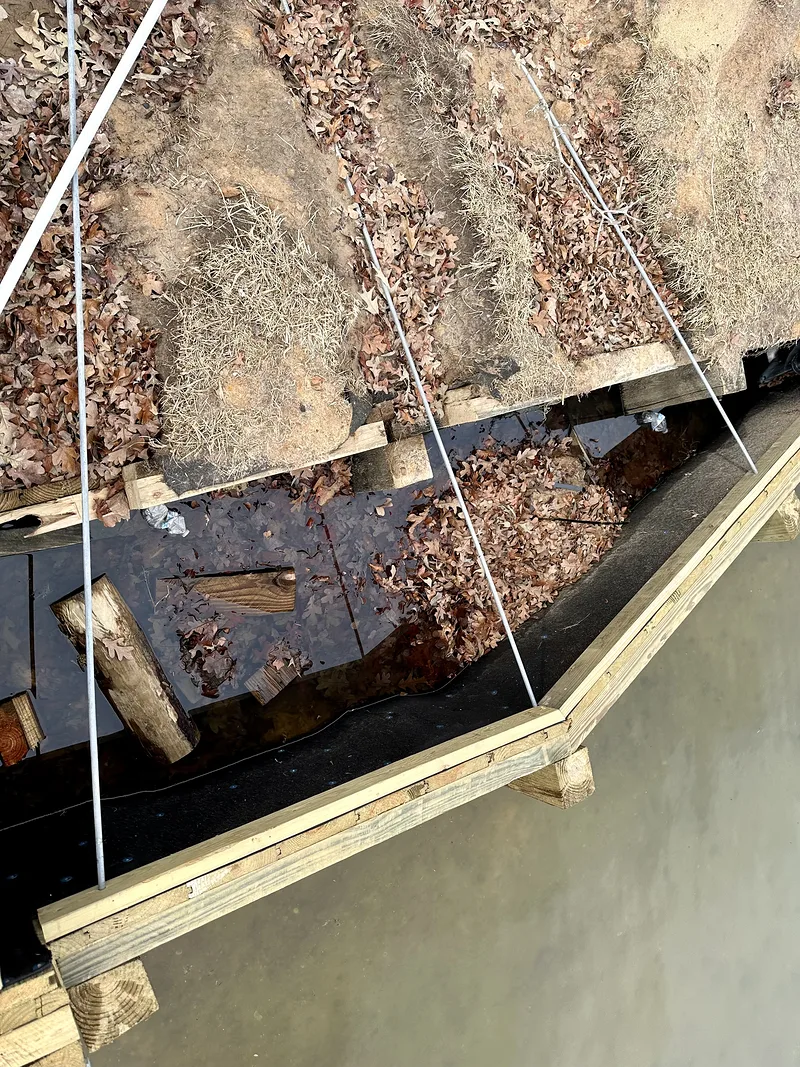
Driving the new wall outboard keeps the old one retaining soil, badly but continuously, right through construction — the alternative is opening an unsupported bank on a lot with a lawn, mature trees and a house on it. To be clear about what that is and is not: the failed wall carries no load, and two walls is not twice the strength. It is the sequence that avoids turning a wall replacement into a slope-stability emergency. The stringline is structural too — sheet piles act as a wall only because they interlock, and a separated interlock is a full-height slot for your yard to wash out through.
Most of what fails announces itself first.
You don't need a contractor for the first pass, and doing it twice a year is worth more than any warranty. Go at low water if you can, and photograph anything you are unsure about. Look for change rather than perfection: weathered timber is normal, but a cap that has moved, a bolt you can turn with your fingers, or a depression that was not there last spring are the structure telling you something while it is still cheap to answer.
Look at the steel, not the wood
White powdery deposit on galvanized hardware is normal zinc doing its job. Red rust means the zinc is spent and the steel is being consumed — and a bolt that has lost a third of its section has lost about a third of its strength.
Put a wrench on the bolts
Timber shrinks, checks and relaxes, particularly in the first few years, and bolted joints need checking and re-tightening. Nobody should sell you through-bolting as install-and-forget, and we will not either.
Sight along the top of the wall
Stand at one end and look down the cap. A wall tipping outward at the top with its base still in place is the signature of a missing or failed anchor. Open joints and daylight between panels belong in the same conversation.
Walk the yard behind it
Soft spots and small depressions mean fines are leaving through the wall. Check the piles too, at six-month intervals, for decay, splitting and insect damage — a structure usually fails in the storm because of a condition it already had.
Photograph everything before you clear one board.
The most common regret after storm damage is a shoreline that got tidied up before anybody documented it.
Shoot from the water and from the bank, wide and close, before anything is hauled off. Get the connections in frame, not only the wreckage: what pulled out, what sheared, what is still bolted to what. That is the evidence of how it failed, and it is gone the moment cleanup starts.
Then the repair-or-replace question. If the substructure is sound and the damage sits above it, repair is often the right call and the cheaper one. If the piles moved, or the wall lost its geometry, rebuilding the same thing the same way buys the same outcome on a schedule the weather sets. And if what you want is the cheapest temporary patch to get a property sold, we're not the right builder for it.
Build quality and storm damage FAQ.
How can I tell if a boathouse was built well?
Look at the connections rather than the timber. At the primary frame joints you want to see bolts passing all the way through with a nut and a washer on the far side, not nails, lag screws, or thin sheet-metal hangers, which depend on many small fasteners and corrode fastest in permanently wet copper-treated timber. Look for diagonal braces at the corners, in more than one plane. Then look at the hardware itself: a dull grey hot-dip coating rather than the bright shine of electroplating. The first two are visible from a boat; the hardware needs a closer look.
Why do boathouse roofs blow off first?
Because an open-sided roof is loaded upward on both faces at once. Wind flowing underneath pushes up on the underside at the same moment flow across the top pulls up, and the two add rather than cancel. Roof-to-frame connections are also the ones most often made for gravity only, so the load arrives first at the link least prepared for it. Once the roof plane leaves, the frame loses its bracing action and racks.
How long does a boathouse last?
We will not put a number on it, and we would be careful with anyone who does. Service life depends on preservative retention, how much of the structure stays wet, water chemistry, how far the lake draws down each year, and whether the hardware is ever looked at again. What we will say is that the structure a storm tests is the structure as it exists that day, not as it was built — and corroded hardware de-rates the whole thing while nothing about the wood looks any different.
Is composite rebar better than steel rebar?
It is better at one specific thing, and that thing is the one that matters in water. Glass fibre reinforced polymer bar contains no iron, so it cannot rust, and because it cannot rust it cannot generate the expansive corrosion product that splits concrete apart from the inside — which is what ends most reinforced concrete on a shoreline. It is not a drop-in substitute for steel, though, and we would not want anyone told otherwise. Its stiffness is roughly a quarter of steel's, so members reinforced with it are governed by deflection and crack width rather than by strength, and generally end up larger. It cannot be bent on site, because the resin is cured before it leaves the factory. And it has degradation pathways of its own, which is why ASTM D7957 screens bar for moisture absorption and alkaline resistance rather than assuming it is immune to everything. Bars pulled out of fifteen- to twenty-year-old bridges have shown very little measurable loss. That is the evidence that exists, and it is fifteen to twenty years long, not a hundred.
Why is my seawall leaning toward the water?
A wall with no working restraint near the top rotates about a point down inside its embedment, so the top moves the most. That is the signature: the base is more or less where it was and the cap has tipped out. It usually means there was never a tie-back, that the rods have stretched or corroded through, or that the anchors were set inside the block of soil that is already trying to move.
Can a leaning bulkhead be repaired, or does it have to be replaced?
It depends on what actually failed. A wall that is sound but under-restrained can sometimes be brought back into service with new anchorage and drainage. A wall that has lost its geometry, or one whose sheets have separated at the interlocks, is a replacement. Dave will tell you which one you have before quoting either, because the two jobs are not close in price and guessing helps nobody.
Why is there a sinkhole in my yard behind the seawall?
Fine soil is leaving through the wall. Water draining out through weeps, joints or a separated interlock carries particles with it unless a filter fabric is holding them back, and the voids that leaves eventually show at the surface as depressions. It is a warning about the wall, not a lawn problem — the soil going out through the gaps is the soil that was supporting the wall.
Will you guarantee my boathouse survives a hurricane?
No, and nobody honest will. Every structure has a load beyond which it fails, and we do not publish a wind rating, because a number like that means nothing without the exposure and design assumptions it was checked against. What we stand behind is the work itself — our guarantee typically runs 2 to 5 years on the large Texas and Louisiana lakes and up to 10 years on private ponds and small lakes, with the terms set out in your agreement for the job.
Related services.
Send Dave a photograph of the connections.
Whether it is a structure you are planning or one you already own, close-up photographs of the joints and the top of the wall tell him more than a description ever will.