The Boat Comes Out
And often the lift bunks or cradle, with power to the lift isolated. The roof and frame normally stay standing.

Many of the slips we are called to look at are not silted in — the lake is low. The ones that are silted in can get back only the depth the pilings holding the roof up will allow. Both questions are answerable before anyone quotes anything.
The boat touches bottom. That is the same symptom for two entirely different problems, and only one of them is a dredging job.
Separate them by reading the shape of the bottom rather than the depth. Silt does not arrive evenly; it settles hardest where the water is stillest, which inside a slip is the back corner, behind a lift, and along the sheltered side. So a genuinely silted slip sounds shallower at the back than at the mouth, and the difference grows as it worsens. A low lake takes the same amount off the whole slip at once and leaves the profile the shape it always was.
Sounding twice, at two different pool elevations, settles it. If every reading moved the same amount and kept its relative shape, that is level. If the back corner lost more than the mouth, or barely recovered when the lake came up, material has arrived. Why it keeps arriving is on the precision dredging page.
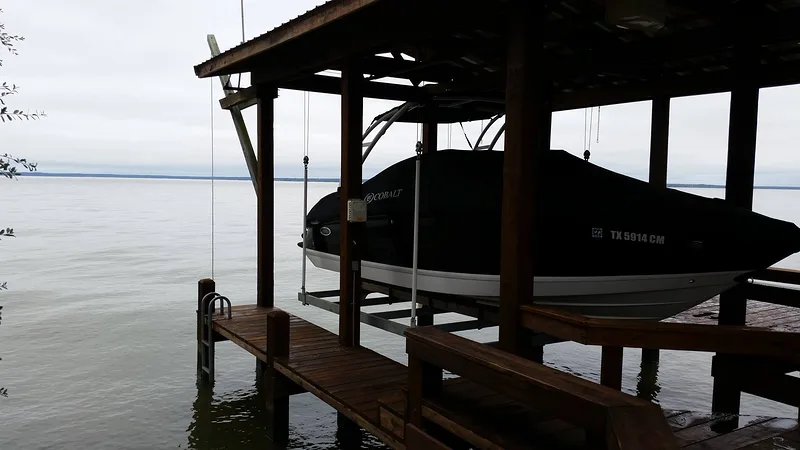
Arrive at the conversation with numbers and you will get a straight answer instead of a site visit that only establishes what you already suspected.
A length of conduit or a broom handle marked in feet, or a weighted line on a cleat hitch. Anything you can repeat next season with the same tool.
Four corners of the slip and the centre. Add a sixth just outside the mouth as a control — it is the one that tells you whether the whole area moved or only the inside.
Your authority publishes the pool elevation daily. A depth without the elevation it was taken at cannot be compared to anything, which is what makes most owners' measurements unusable.
With the boat out and the level down, a phone photograph down each side of the slip shows more about the bottom and the pile line than any description will.
This is the part of slip dredging a dredging-only contractor is least equipped to answer, and the reason we look at the structure before the water.
The piles under your boathouse were driven to suit the bottom that existed then. Their capacity comes from embedment — the length of pile in the ground — and from the soil around them giving lateral support. Take two or three feet out from around a pile and you have reduced both. On a structure already marginal, or driven into soft material, that is how a dredge ends up owning a boathouse problem it did not create.
So the sequence runs the other way round from how it is usually sold: pile condition and embedment first, target depth second, the dredge limit drawn to leave material standing at the pile line. Sometimes the honest answer is that the structure needs attention before the water does. We would rather say that on the bank than discover it mid-job.
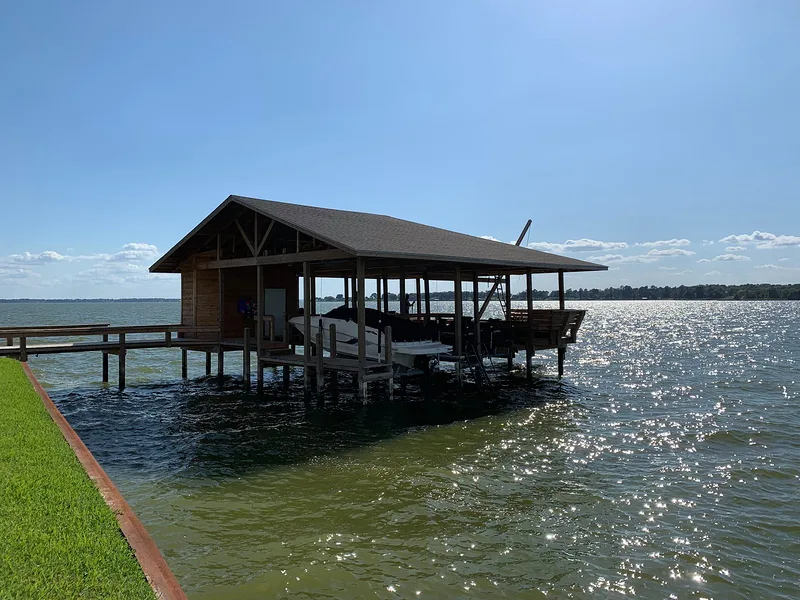
A single slip is a small job with a lot of logistics attached, and most of the surprises are logistical.
And often the lift bunks or cradle, with power to the lift isolated. The roof and frame normally stay standing.
The rig launches somewhere and runs to you. Ramp availability, overhead lines and the depth of the approach can matter more than the slip itself.
It has to run from the cut to wherever the material is permitted to go, and that route crosses your frontage. Agreed before mobilizing, not during.
Silt curtain across the slip opening keeps what is stirred up inside the footprint being worked, which is a permit condition as often as a courtesy.
Owners are frequently surprised by this. On the river-authority lakes the property owner is the applicant, not the contractor: the authorization attaches to your property and to the scope approved — location, volume, target depth. It is displayed on site while the work runs, the work is open to inspection, and changing the approved scope means going back to the authority rather than deciding it on the water.
Practically, the application is worth getting right first time, because it governs what can actually be taken out. We put together the technical detail it asks for and work inside whatever comes back. Which body you are dealing with, and what sits above it, is on the dredging hub and your own lake's page.
A residential slip is a confined job. The barge has to fit between structures that are staying, and the discharge has to reach somewhere it is allowed to go.


Read the shape of the bottom, not the depth. Silt arrives unevenly and builds deepest in the quietest corner, so a silted slip sounds shallower at the back than at the mouth. A low lake takes the same amount off everywhere and the profile keeps its shape. Sound it twice at different pool elevations and the answer is usually obvious.
Usually not. The reach and positioning of an excavator arm is the whole reason this rig suits slip work, where a full-size cutterhead has no room to set up. The boat comes out, lift bunks or a cradle may have to come off, and power to the lift is isolated. The roof and frame normally stay where they are.
It can, and this is the question a dredging-only outfit is least equipped to answer. Your pilings were driven for the bottom that existed then. Taking material out from around them reduces embedment and lateral support, so the pile condition and how deep they actually go are established before a target depth is set, and the cut is drawn to leave material at the pile line.
Sometimes, and it is a per-permit answer rather than something we can promise in advance. Some authorities allow placement on approved adjacent property and some require the material to leave the reservoir entirely. Upland placement is not automatically unregulated either. It is settled during the application, not on the day.
On the river-authority lakes the property owner is the applicant, and the authorization attaches to your property and to the scope that was approved. We put together the technical detail it asks for, including the location, the volume and the target depth, and we work inside whatever comes back. Changing an approved scope means going back to the authority.
Those numbers, the slip dimensions, a photograph down each side with the boat out, and a note on how a barge would reach you. Enough for Dave to say whether this is a dredge at all.