Framing repair
Beams, stringers and joists replaced or doubled where they have split or gone soft at a bearing. Bracing renewed where a frame has racked out of square.

Most owners call about the boards, and the boards are the cheapest thing out there. What decides whether a dock has five more years or twenty-five is the piling, the framing and the hardware nobody looks at.
Piles, frame, deck and hardware fail on separate clocks. Repair is finding which clock has run down.
Shoretech repairs fixed timber docks, piers, walkways and the substructure under boathouses — on structures we put in and on plenty we did not. A repair visit is a diagnosis before it is a quote, because the four layers do not age together. Decking takes sun, traffic and standing water and goes first. Hardware runs on a corrosion clock nobody watches. Framing fails quietly at the connections. The piles, which are the whole structure, go at one height while looking fine everywhere else.
New decking over soft stringers is money on the wrong layer, and it hides the problem rather than fixing it — so we start at the bottom and tell you which layer you are buying.

A post-and-beam joint is where load changes direction, and where a failing dock almost always fails first.
A bolt that has lost its section, a washer crushed into softened timber, a nailed connection where a through-bolt belonged: none of it shows from the deck, and all of it is repairable if found in time. Shoretech has been building waterfronts for more than 40 years — over 250 boathouses and 850-plus projects — and what we know about corrosion and detailing is what we bring to somebody else's.
Not the mud line, and not the top. The few inches alternately wet and dry are where fresh water takes timber apart.
A screwdriver at the waterline tells you more than a photograph of the whole dock. Sound timber pushes back. Add the visual tells — hourglass narrowing, rust bleeding from a bolt hole, a pile out of line.
Where the loss is local, a new pile is driven hard alongside the old one and the framing transferred onto it with new through-bolted hardware. Done properly this is a structural repair, not a splint.
When a whole line of support has gone, the deck is shored, the old timber comes out and new piles go in on the original grid so the framing lands where it was designed to.
Some of this is a morning's work. Some is a barge for a week.
Beams, stringers and joists replaced or doubled where they have split or gone soft at a bearing. Bracing renewed where a frame has racked out of square.
New surface over framing that has been probed and proven. Timber or composite — and if composite, joist spacing is measured first, because the board is rated by the span it crosses.
Bolts, washers, brackets and connectors replaced in hot-dip galvanized or stainless. Mixed metals and undersized fasteners are what we find most.
Posts, beams, knee braces and the bolted connections carrying a roof and a lift. Roofing and flashing renewed where the frame checks out.
The beams, brackets and through-bolts a lift hangs from take a load nothing else sees. We reinforce the structure; mechanicals go to a lift technician.
Re-decking a dock whose frame is genuinely good transforms it for a fraction of a rebuild. The condition is the word "genuinely."
Every board comes up, the framing gets probed rather than glanced at, anything soft is replaced, and only then does new surface go down. A bouncy deck was telling you about the frame, and new boards make the symptom disappear while the problem carries on.
If the surface is composite, spacing decides everything. The board is rated by the span between supports, and plenty of older frames were built at wider centres to suit treated pine. Sometimes that means adding framing, sometimes a different board. The decking page sets out how we specify it.
Fasteners that have lost their section leave no margin, however good the timber looks.

Rust streaks are a diagnosis. A dark stain under a bolt head means the fastener is corroding inside the timber, where you cannot see how much is left. We pull a sample rather than assume.
Mixed metals cause their own trouble. A coated screw in a stainless assembly, or a plain bolt replacing a galvanized one, creates a corrosion problem where there was not one. Repairs are where this creeps in.
Crushed washers mean soft wood. If a washer has pulled into the timber the fastener is no longer clamping anything, and that connection needs new wood. Through-bolting a toe-nailed joint, meanwhile, is one of the highest-value repairs on an otherwise sound dock.
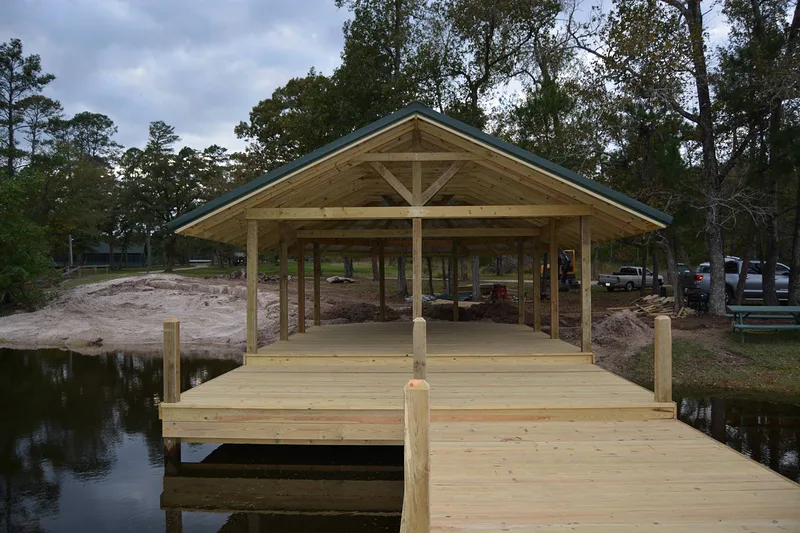
A boathouse is a dock carrying a building, and often a boat in the air. Everything below the deck does more work.
When a boathouse starts to move, owners describe the roof, because that is what they can see. It is rarely where the trouble began. Panels, fasteners, trim and flashing are a replaceable layer, but they only stay put if the rafters, beams, posts and connections under them are holding line. So the substructure is inspected first: knee braces tight and in plane, beams sound at the bearings, posts probed at the waterline, through-bolts checked rather than assumed. If a structure is past repair, a new boathouse is a conversation to have early. The whole sequence — roof, framing, posts, hardware, deck and lift structure, and which of the six is actually the one that has run down — is set out under boathouse repair.
A structure that looks intact after a big weather event may have been loaded in directions nobody designed for.
Start at the shore end and work outward. Backfill washed out from under an approach or a stair landing is the most common finding and the easiest to miss, because the surface above still looks level. Then debris: anything lodged under the deck or against a pile is still applying load, and gets documented before it is moved. Then the deck — boards lifted, fasteners pulled or backed out, the signature of uplift rather than of something striking it. Underneath, split framing at connections, elongated bolt holes, bracing gone slack.
Anything electrical that was submerged gets inspected by an electrician before it is energised, and a lift that went under should not be run until it has been looked at. We assess a structure on what we can see and probe on the day. If a shoreline wall took damage too, start with the seawall and bulkhead repair guide, or how walls fail on Lake Livingston.
Probe them, do not look at them. Put a long screwdriver into the band that is alternately wet and dry — right at the waterline — and push. Sound timber resists; a failing pile takes the point under hand pressure. The top can look perfect while the working height has gone.
Often, and it is the best value in dock repair when the frame is sound. We probe the stringers and beams first, because a bouncy deck felt that way for a reason. And if you want composite we measure joist spacing, since a frame built for treated pine may not be rated for that board.
Where the sag sits tells you. A dip between two piles that are still true is usually a beam or a run of stringers. A dip centred on a pile points at the pile or the connection on top of it. A section gone out of square has lost a brace.
Usually yes. Panels, fasteners, trim and flashing are a separate layer from the frame carrying them. What decides it is the framing underneath — rafters, beams, and the bolted connections into the posts.
Work from the bottom up: backfill washed out at the shore end, debris lodged under the deck, boards lifted or fasteners pulled, split framing at the connections, bracing gone slack. Anything electrical that went under gets inspected by an electrician before it is switched on.
When the piles are gone. Everything above them can be renewed piece by piece, but once most piles have failed at the waterline you are building a new dock around old timber. The other stopping point is repetition: if a repair only buys a season, put the money into the structure.
Send photographs of the dock end on, the underside if you can reach it, and any pile at the waterline. Tell Dave what changed and when — a new sag, a board that moved, a roof panel that lifted.