Repair in place
Cap and wale replacement, a blown panel or two, tie-backs renewed, a joint closed and the filter and backfill rebuilt. Right when the piling is sound and the damage local.

Locals call it a bulkhead. People who moved here call it a seawall. Same wall, same failure, and the reason is a lake that never lowers.
TPWD puts annual fluctuation at one to two feet around the 131-foot normal pool, with no winter drawdown. That fact writes most of this page.
The lake is held close to a steady level to do its one job — water supply for Houston and the counties around it. For a fixed pier that is a gift: build tight to the waterline and you know where the water will be. For a wall it is the opposite. Wetting and drying, wave impact, debris and ultraviolet all land in the same narrow band, month after month, instead of being spread up and down the bank by a winter drawdown.
Fetch does the rest. The lake runs roughly 31 miles down the Trinity River valley and up to 9 miles across, so a wall on the open basin takes chop that has had miles to build while a wall a mile away on a dug canal barely sees a ripple. Third is the water on your side: most walls we open here failed not because the lake pushed in, but because rain soaked the backfill, the wall could not let it out fast enough, and soil left through the same joints the water did. The Florida seawall pages that fill these results explain tidal vacuum and storm surge. Neither exists here.
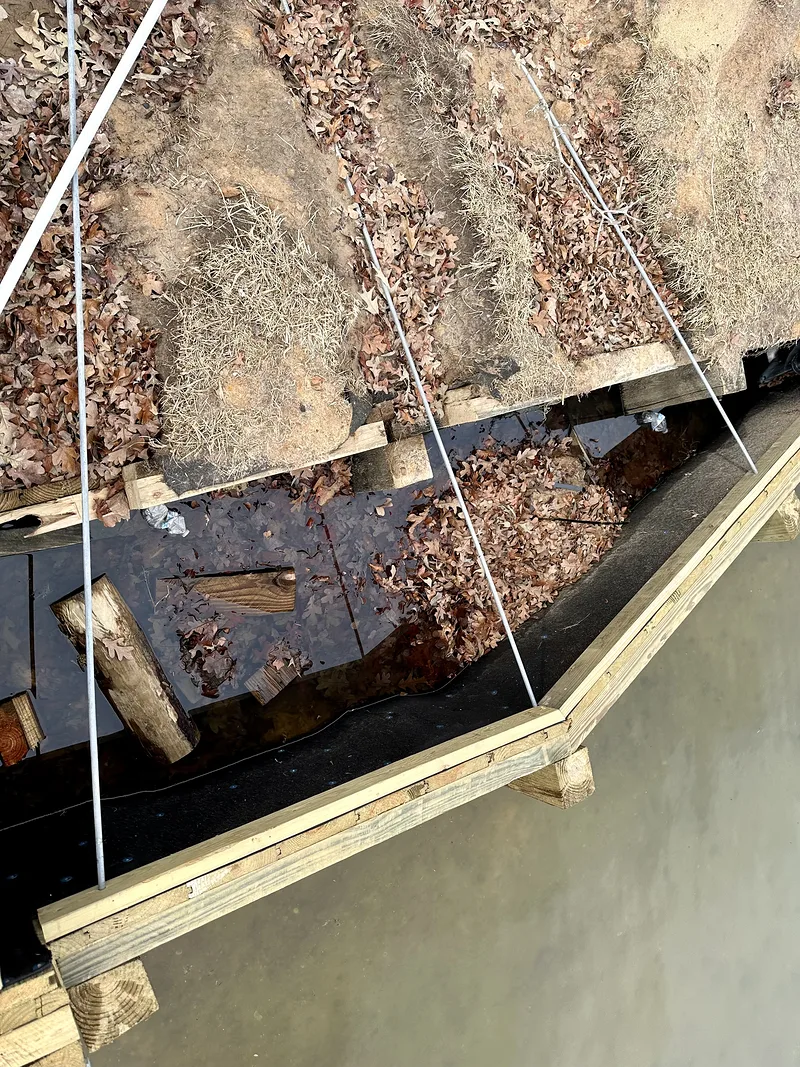
A wall that still looks straight from the yard can be holding almost nothing. The collapsed timber here was invisible from the lawn until the new wall went in ahead of it.
Shoretech has been building waterfronts for more than 40 years — over 250 boathouses and 850-plus projects — and Lake Livingston is home water, worked from a base in Trinity. The lake-wide page covers the water and the permitting program; this page is about walls already in trouble.
The symptom-by-symptom walkthrough for any lake lives in our repair diagnostics guide. This is the Livingston edition.
Not at the bottom, where owners expect it. The killer zone is the few inches that are wet and dry over and over. Probe there with a screwdriver: if it sinks in under hand pressure, that piling is finished.
Panels shrink, boards cup, a seam opens a quarter inch, and every rain washes more yard through it. When the lawn finally dips, the void underneath is far larger than the dip.
Rods run back to anchors buried in the bank and hold the top of the wall in line. When they corrode through or pull, the wall rotates and the cap opens up.
Wave energy reflects off a hard vertical face and digs at the lakebed in front of it. On open basin that hole deepens each windy season, until a wall that was adequate when built stands in less ground than it was designed for.
Roof runoff, a sloped yard and blocked drainage add up to real pressure after every wet week. Restoring the filter fabric and the drainage path is what stops a repair repeating.
Owners fear being sold a whole wall when only a section is bad. That fear is reasonable, so here is the reasoning we use out loud — and the tests behind it are written out in full under bulkhead repair or replace.
Cap and wale replacement, a blown panel or two, tie-backs renewed, a joint closed and the filter and backfill rebuilt. Right when the piling is sound and the damage local.
A defined length comes out and goes back new, tied into the old wall at both ends. Right when one stretch — an exposed corner, a return at a property line — has gone while the rest has years left.
Sometimes the cleanest answer is driving a new wall just in front of the failed one and backfilling between, as in the photograph above — moving the structure onto sound ground.
When the waterline band has gone along most of the run, or patching means coming back twice more inside a few years. Better said at the assessment than discovered halfway through.
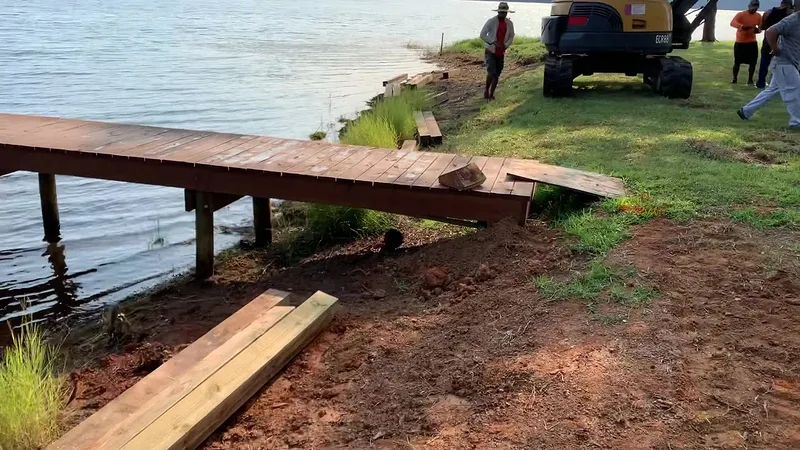
Dave walks the wall end to end, probes the piling through the waterline band, checks the cap for movement, the tie-backs for tension and the toe for scour, then says which of the four the wall is in. What moves the number is the site, never a per-foot chart: height and length, the soil behind it, canal versus open basin, access down the bank, and the material.
Trinity River Authority, Lake Livingston Project — permits office 936-365-2292, applications through the online portal on MyGovernmentOnline.
TRA holds fee ownership of the lakebed up to the 131-foot normal pool, with a flowage easement above it. The wall at your waterline stands on TRA ground, not on your deed. Bulkheads run under TRA's own shoreline application rather than under USACE Galveston District General Permit SWG-2007-00720, the vehicle covering piers, boathouses, shelters and lifts.
The point owners miss: replacing a wall is not maintenance. It is reviewed as construction, with drawings and dimensions — so "we are only putting the same wall back" saves nobody any time, and it changes the arithmetic on partial versus full rebuilds. County requirements stack on top, city permits apply inside city limits, and gated subdivisions add architectural review. Shoretech carries all of it as one package.
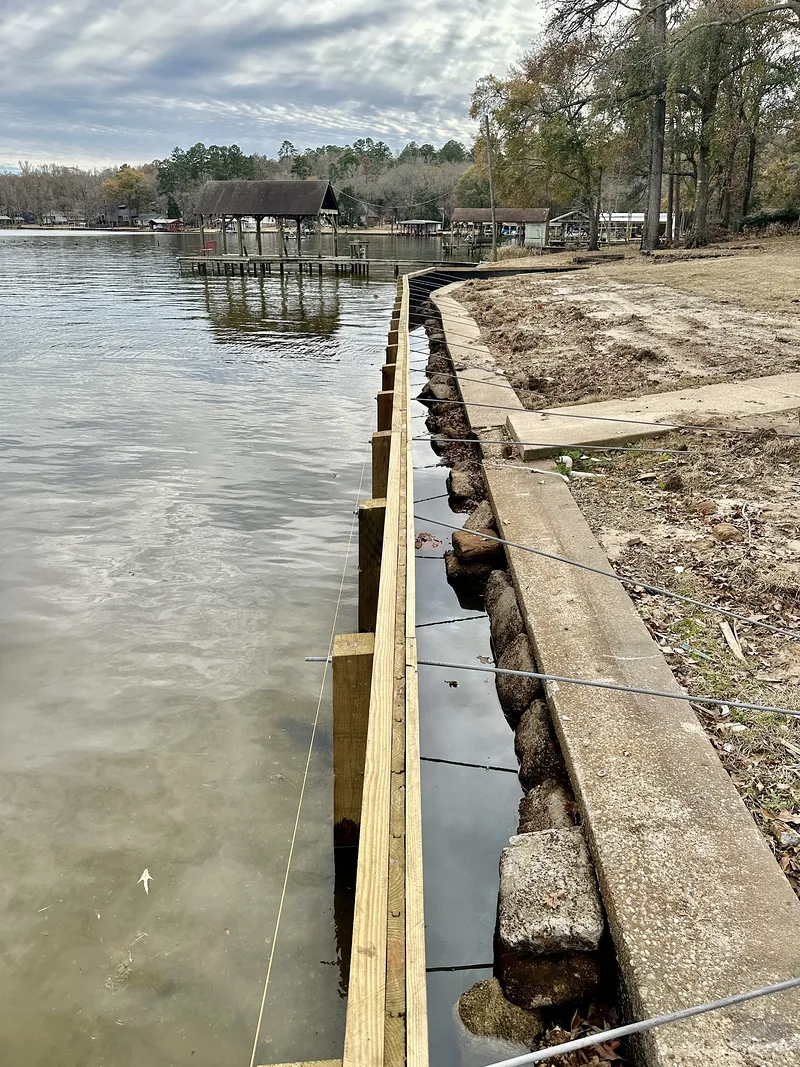
Same lake, four counties, banks that behave nothing alike.
A canal wall and an open-basin wall are different structures with different lives, even inside one subdivision — worth establishing on the phone.
It depends what the wall still has left. A lifted cap over sound piling, a blown panel, a washed-out return, a failed run of tie-backs — those are repairs. What rules a repair out is the piling: once it has gone soft along most of the run, there is nothing to fasten a patch to.
Assume yes. TRA owns the lakebed up to the 131-foot normal pool, so the wall stands on TRA property rather than yours, and bulkheads run under TRA's own shoreline application. A replacement wall is reviewed the way a new one is. Permits office: 936-365-2292.
Because the lake barely moves. TPWD puts annual fluctuation at one to two feet around the 131-foot pool with no winter drawdown, so wetting, drying and wave attack concentrate in one narrow band instead of migrating up and down the bank.
Treat it as serious. A depression at the surface is the last stage, not the first — soil has been leaving through a joint, a split panel or under the toe for some time. Filling it with dirt changes nothing: the escape path is still open.
There is no published number, and anyone giving you one over the phone is guessing. Lean alone is not the verdict. What we measure is whether it is still moving, whether the cap has opened, whether the tie-backs hold, and whether ground is disappearing behind it.
The whole reservoir. Shoretech is based in Trinity on the upper lake and works the full 31 miles of it — canal and open-basin frontage mid-lake, the east-shore subdivisions, the San Jacinto County side, and the riverine banks at the top end.
Three photos help more than a paragraph: the full run from one end, a close-up of the cap, and anything odd in the lawn behind it. Tell Dave which subdivision the lot is in, and whether the frontage is canal or open basin.