Private Docks & Piers
Fixed, floating and swim piers on frontage that typically runs on the order of 150 feet, with deck elevations set against the flood storage above the pool rather than against today's water line.

A quiet 2,212-acre city water-supply lake on Loco Bayou, ten miles west of town. No river authority, no Corps office — the City of Nacogdoches owns it, and the rules for what you build sit in the city's own code of ordinances.
Lake Nacogdoches is owned and operated by the City of Nacogdoches as a municipal water supply, so the city — not a river authority, not the Corps — is the permitting body.
The governing rules are in Chapter 114, Waterways, of the Nacogdoches Code of Ordinances. What the code does establish is clear enough. A private dock is defined as any boat dock or structure, fixed or floating, placed upon the waters of Lake Nacogdoches for pleasure purposes only and producing no revenue, direct or indirect, to the owner. No person may launch a boat except at points designated and authorized by the city council. Any privately owned launching ramp or device must be constructed and maintained in accordance with the code division governing docks and other structures. And commercial activity — boat rental, or a concession business — requires a commercial permit and a license fee set by the council.
What is not publicly settled is exactly the operational detail a homeowner and a contractor need: which city department accepts and issues the private dock permit, the application form, the fee, the review timeline, and whether bulkheads, retaining walls and boathouses are permitted at all and to what standard. Rather than guess at any of that, Shoretech confirms it directly with the City of Nacogdoches before a scope or a price goes on paper. On a small lake with one landowner, that is a short conversation — but it has to actually happen.
There is a second unsettled question worth raising early on any specific tract: whether the city owns shoreline land above the conservation pool, or whether private ownership runs to the water. That materially changes who signs off on a project, and it is worth establishing before a design is drawn.
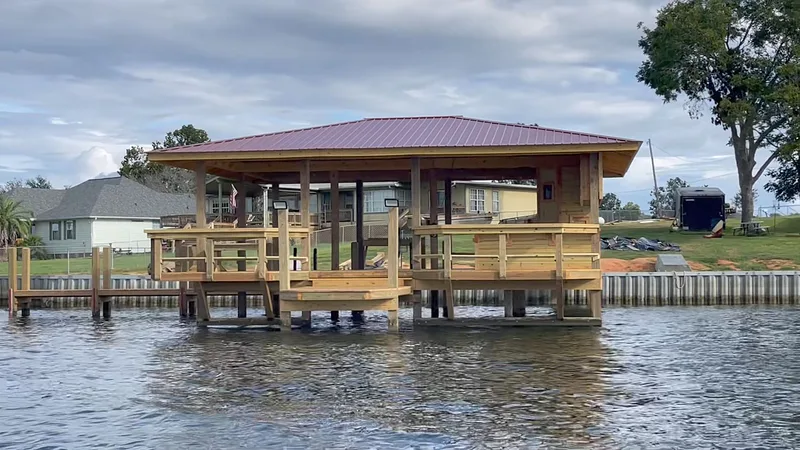
New boathouse and steel bulkhead on Lake Nacogdoches — a covered slip standing over the water with a sheet-pile wall holding the shoreline beside it.
Building the structure and the shoreline retention as one package keeps the bulkhead line, the walkway, and the boathouse substructure set to the same water level and the same soil — instead of a dock built to one assumption and a wall built later to another.
Conservation pool is 279 feet above mean sea level, and TPWD rates fluctuation at 1 to 3 feet — a stable lake by Texas standards.
The number worth carrying into a design here is the storage above that pool. Lake Nacogdoches holds 42,318 acre-feet at normal pool against a maximum capacity of 122,000 acre-feet, which means there is substantial flood storage above the conservation elevation. A dock deck set only against the everyday water line is set against the wrong number. The lake covers 2,212 acres — the one figure where TPWD and other published sources actually agree — reaches about 40 feet deep, and was impounded in 1976 behind a Loco Bayou dam designed by Freese & Nichols. Loco Bayou is a tributary of the Angelina River. Shoreline is commonly given as about 16 miles, though that comes from lake-listing and real-estate sources rather than the city or TWDB.
For fishable structure, TPWD lists aquatic vegetation edges — primarily hydrilla and American lotus — plus points, creek channels, boat docks, and artificial habitat structures installed by TPWD with Nacogdoches County and the Reservoir Fish Habitat Partnership. Water clarity runs moderately clear.
What TPWD does not publish for this lake is any bottom-composition description or bank character. That is a real gap for a marine contractor, and the honest response to it is a site check rather than an assumption: pile conditions on Lake Nacogdoches get established at the property, with a probe, before a wall or a boathouse substructure is priced. A small East Texas bayou impoundment can be soft mud in one cove and firm in the next.
Small-scale by nature — usually a single property rather than a run of neighbouring lots.
Fixed, floating and swim piers on frontage that typically runs on the order of 150 feet, with deck elevations set against the flood storage above the pool rather than against today's water line.
Covered slips with open-gable cooling, lifts and lighting — subject to confirming the city's current standard for roofed structures on this lake before design.
Steel, vinyl, FRP composite and heavy timber walls, plus minor bank stabilization — specified after the bottom is probed, since no published description of it exists.
Private launching ramps built to the code division governing docks and structures, plus slip and access dredging with material pumped for reuse.
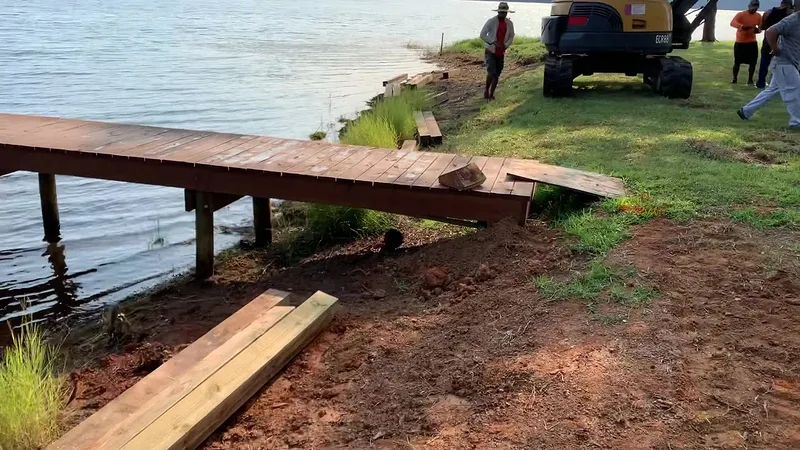
Shoreline prepared for a new bulkhead beside an existing timber pier — the eroded bank cut back, the wall alignment set, and access opened for the crew and the excavator before the first panel is driven.
Work around a pier that is staying puts the constraints up front: keep the existing structure protected, tie the new wall cleanly into it, and leave the owner a shoreline that reads as one continuous waterfront rather than two projects meeting in the middle.
This is a Nacogdoches-and-Douglass local market rather than a destination lake — which shapes both the work and the scheduling.
The waterfront is a handful of lakefront homes and lots with private floating metal docks, a couple of community ramps, and no commercial marina. Volume here is low and a job is usually a single-property job rather than a run of neighbouring bulkheads — which is exactly why the permitting question gets answered by phone before anyone drives out. Shoretech is based in Trinity, an easy haul west. The town page for docks, boathouses and bulkheads in Nacogdoches covers the city side of that work.
The City of Nacogdoches. The lake is a municipal water supply owned and operated by the city, and the rules for docks and other structures sit in Chapter 114 — Waterways — of the Nacogdoches Code of Ordinances. There is no river authority here and no Corps of Engineers lake office, which makes this a different conversation from every other lake in the region.
It defines a private dock as any boat dock or structure, fixed or floating, placed upon the waters of Lake Nacogdoches for pleasure purposes only and producing no revenue, direct or indirect, to the owner. It also provides that no person may launch a boat except at points designated and authorized by the city council, that any privately owned launching ramp or device must be built and maintained in accordance with the code division governing docks and other structures, and that commercial activity — boat rental or a concession business — requires a commercial permit and a council-set license fee.
That is the question to settle first, in writing, with the City of Nacogdoches. The published code text available to us does not resolve whether bulkheads, retaining walls and boathouses are permitted and to what standard, nor which department issues the private dock permit, the form, the fee or the review timeline. Shoretech has built a boathouse and a steel bulkhead on this lake, so it is not a theoretical question — but it is answered by the city, property by property, before anything is quoted.
The size of the structure and its deck height — set against the flood storage above the 279-foot pool, not just today's water line — the water depth at the outer end, the bottom itself, which has no published description on this lake and gets probed at the property, the condition of the bank, access to the site, and the material: steel, vinyl, FRP composite or heavy timber. The city's requirements shape the design too. That is why pricing starts with a site visit and a probe rather than a number over the phone.
The city comes first: Shoretech settles the City of Nacogdoches' current requirements in writing before a design is drawn, then builds to the answer that comes back. Once the permitting is settled, most work here is single-property scale — a pier, a boathouse, a run of bulkhead — so the build itself is usually the shorter half of the calendar. Dave walks the frontage and gives a schedule with the proposal.
Yes — Lake Nacogdoches is inside the core service area, a short haul from the Trinity base, and the photographs on this page are Shoretech's own completed work on this lake. Call Dave at 936-662-5100.
Tell Dave what your frontage looks like and what you want at the water. He will settle the city's current requirements in writing first, then design to the answer that comes back.