Docks, Piers & Swim Platforms
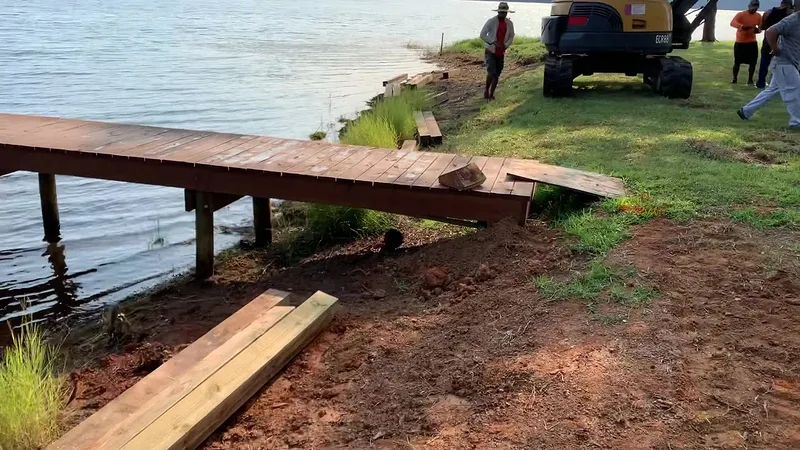
Reaching past a vegetated shallow margin to usable water, with the deck set against the storage above the 279-foot pool, not the day's water line.

A university county seat on US 59, with its lake ten miles west on FM 225 — and one city government owning the water, the dam, the parks and the rules.
Nacogdoches is a working East Texas city of 32,147 at the 2020 census across roughly 27.7 square miles. Its lake is a separate place, ten miles west.
The city calls itself the oldest town in Texas — a long-standing municipal claim rather than a settled fact, and worth stating the way the city states it. What runs the place today is not in dispute. Stephen F. Austin State University brings some eleven thousand students and, along with Pilgrim's Pride, is one of the two largest employers in town, with healthcare, manufacturing, agriculture and lumber around them. US 59 is the corridor: about 140 miles northeast of Houston, 90 southwest of Shreveport.
For waterfront work the geography matters more than the history. Lake Nacogdoches sits about ten miles west via FM 225 and is an impoundment of Bayou Loco — a tributary of the Angelina River, in the Neches basin, not the San Jacinto. Nacogdoches ISD serves the city; Douglass ISD covers part of the lake area. A town mailing address and a lakefront tract can be twenty minutes apart, which is worth establishing in the first phone call.
City of Nacogdoches, 936-559-2960 — the same office for the water supply, the parks and what you are allowed to build on the shoreline.
On most Texas lakes an owner deals with a river authority, sometimes the Corps of Engineers on top of it, and a county or city underneath. Here there is one body. The city owns and operates Lake Nacogdoches as its municipal water supply, and the rules for structures sit in Chapter 114, Waterways, of the Nacogdoches Code of Ordinances. It defines a private dock as a structure, fixed or floating, placed on the waters of the lake for pleasure purposes only and producing no revenue to the owner — and it holds a privately owned launching ramp to the same construction standard as a dock.
What the published text does not settle is the working detail: which department issues the permit, the form, the fee, the review time, and whether bulkheads and boathouses are addressed as their own category. We do not guess at that. Shoretech confirms the city's current requirements in writing before a scope or a price goes on paper — a short conversation on a lake with one landowner, but one that has to happen. The broader picture of the water itself is on the lake page.
Most jobs on this shoreline are one owner and one frontage rather than a run of neighbouring lots.
Reaching past a vegetated shallow margin to usable water, with the deck set against the storage above the 279-foot pool, not the day's water line.
Covered slips with lifts, lighting and open-gable cooling, designed after the city's standard for roofed structures is confirmed for the tract.
Steel, vinyl, FRP composite and heavy timber walls, specified once the bottom has been probed, since nothing is published about it for this lake.
A leaning wall, a void behind it or rust at the waterline gets read first — repair and replacement are different jobs.
Piles, framing, decking and hardware on an existing dock or covered slip — assessed before anything is quoted.
Texas Parks and Wildlife puts normal fluctuation at 1 to 3 feet on a 2,212-acre lake reaching about 40 feet at its deepest.
A reservoir that moves that little behaves differently from one on a big seasonal drawdown, and it makes deck and cap elevations a precise decision rather than a hedged one. The controlling conditions are the shelving, vegetated margin — hydrilla and American lotus along the edge — and the bottom, which no public source describes for this lake. Wave fetch is minor on a bayou impoundment with short arms. So the frontage gets probed before a wall or a boathouse substructure is specified.
Texas Parks and Wildlife lists no marina here — public access is two free parks the city runs itself.
Which park a property sits nearest is the fastest way to describe a location on a lake with no marina and few landmarks. Both parks answer at the same city number as the lake itself, 936-559-2960 — another way of saying there is one office to deal with here.
The City of Nacogdoches, at 936-559-2960. The city owns and operates Lake Nacogdoches as its municipal water supply, so the dam owner, the water utility, the parks operator and the regulator are all the same office. Structures on the water are governed by Chapter 114, Waterways, of the city code, and the detail the city does not publish — form, fee and review time — we settle in writing before a design is drawn.
About ten miles west of town on FM 225, in western Nacogdoches County. The city sits on the US 59 corridor and the lake does not touch it — Lake Nacogdoches is an impoundment of Bayou Loco, a tributary of the Angelina River in the Neches basin. Douglass ISD covers part of the lake area while Nacogdoches ISD serves the city, which is a quick way to tell how far out an address really is.
Yes. Steel, vinyl, FRP composite and heavy timber walls, plus bank stabilization, docks, piers, boathouses and private launching ramps. Shoretech has completed bulkhead work on Lake Nacogdoches, and the photograph on this page is from a Lake Nacogdoches shoreline being prepared for a new wall. Trinity is a straightforward haul west, so this is inside the regular working area rather than a special trip.
It means the shallow margin is the design problem here, not wave energy. Texas Parks and Wildlife describes the lake's vegetation as dominated by hydrilla and American lotus, and lists boat docks among its habitat features. Heavy growth along a shelving edge changes where a pier has to reach to find usable water, so it is worth walking the frontage when the growth is heaviest rather than when it looks best.
Length and height of wall, the soil behind it, the bottom in front of it, how far out usable depth sits, the deck elevation chosen against the storage above the 279-foot pool, access for equipment, and the material. The city's requirements shape the design as well. None of that can be judged from a photograph, which is why Dave walks the frontage and probes it before anything is priced.
Tell Dave roughly where the tract sits — which park it is nearest is usually enough — and what you want at the water. The city's requirements get settled first, then the design follows.