Custom Boathouses on Houston County Lake
Entertainment-grade boathouses on Houston County Lake — open-gable cooling, lifts, lighting, and storm-rated substructures.

A constant-level East Texas water-supply lake ten miles northwest of Crockett — where Shoretech rebuilt the Crockett Family Resort marina, and where boathouses, piers and bulkheads can be built tight to a waterline that barely moves.
Quiet East Texas water, built in 1966 to supply drinking water to Crockett, Grapeland and Latexo.
Houston County Lake is a roughly 1,330-acre impoundment of Little Elkhart Creek in the Trinity River basin, about ten miles northwest of Crockett — FM 229 west from Loop 304 is the road out. It exists for one purpose: drinking water for Crockett, Grapeland and Latexo. An earthen dam 1,250 feet long and 63 feet high holds the conservation pool at 260 feet above mean sea level, and the water level barely moves — one to two feet in a normal year.
That stability is the defining construction fact here, and the rest of the lake's character follows from its size. Clear to slightly stained water reaching about 40 feet at its deepest, standing timber in the upper reaches, and two named islands — Paradise Island and Whispering Pine Island — make it a fishing lake first: the trophy largemouth reputation is real, TPWD rates the redear sunfish fishery excellent, and TPWD added fish habitat structures in 2018. A near-constant waterline rewards fixed piers, full-height bulkheads and boathouses built tight to the water, without designing around a big seasonal swing.
The shoreline is reached by a short list of roads — FM 229, FM 2110, CR 2125 and CR 2140 — and the free two-lane county boat ramp on FM 229, about nine miles west of Loop 304, stays open year-round. Most lake addresses run through Crockett, the Houston County seat, with Lovelady to the south — where Shoretech built a family swim pier — and Grapeland and Latexo, the other two towns this water supplies, up the US 287 corridor. This corner of East Texas is well-traveled ground for our crews.
Houston County Water Control & Improvement District No. 1 — office on CR 2125 near the lake, 936-544-3985.
The district owns the lake's water rights and operates and maintains Houston County Dam, and its permit comes before any structure goes in or changes: bulkheads, piers, docks, boathouses, boat ramps and marinas below the 267-foot contour all require district approval. The application states the location and size of the work and carries a construction plan, a nonrefundable permit-and-inspection fee applies, the owner furnishes a release of liability for water damage, and the permit number is displayed prominently on the finished structure.
The district's construction standards are specific, and they shape a design before the first line is drawn. A permitted structure may extend no more than 50 feet lakeward from the shoreline at the 262-foot contour and stand no more than 12 feet tall measured from that same elevation. All lake-facing sides carry red reflectors at least three inches across, spaced no more than 15 feet apart. Every fixed structure must be anchored to withstand anticipated wave and weather conditions, and nothing below the 269-foot contour may be built for habitation. In coves the geometry gets tighter still: structures are allowed only where the inlet is at least 60 feet across at its entrance, 30 feet of clear water is maintained between structures for boat traffic, and nothing extends more than a third of the way across.
Bulkheads have their own rules. A new wall may not be placed below the 260-foot conservation pool; a replacement means the old wall comes out and the new one goes in the same location unless the district directs otherwise; and no bulkhead may fill in the lake. Even stump removal is written down — a lot owner may clear stumps only in front of their own property, line to line, up to 30 feet lakeward of the boathouse. Shoretech verifies the current rules and carries this paperwork with the build — on a drinking-water lake, the approvals are part of the project.
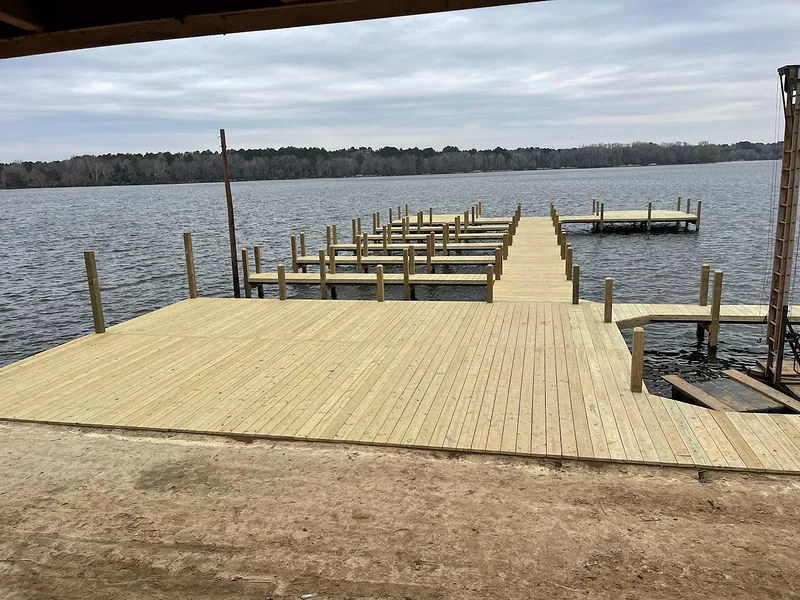
Rebuilt marina slips at Crockett Family Resort, Houston County Lake — a wide wood deck and rows of open boat slips in place of the worn 1980s structure.
Everything shown on this page is Shoretech's own completed work. A commercial rebuild on a working waterfront is a different discipline from a backyard boathouse: the marina had to keep serving the resort while its replacement went up around it.
Crockett Family Resort, on CR 2140 off FM 229, is a TPWD-listed access point on the lake — its marina is working infrastructure, not ornament.
The resort pairs its marina with a boat ramp, boat gas, cabins and RV sites, which means the structure earns its keep every weekend of the season. The marina Shoretech replaced dated to the 1980s — decades of timber standing in the water, carrying decades of family boats — past the point where repair is the economical answer.
Replacement starts with demolition over water. The old structure comes out in sections — decking, stringers, then the pilings themselves — with the material caught and hauled away rather than dropped, because everything that comes out of a water-supply lake has to leave it. What goes back is not a copy of what stood there: the new layout is a small-slip design, rows of open slips off a wide common deck, matched to the boats that actually use this lake rather than to a forty-year-old drawing.
The phasing is the quiet skill in a job like this. A resort marina cannot simply close for a season, so demolition, new pilings and decking are sequenced to keep usable water available through the work. It is the same discipline Shoretech brings to any working waterfront — and the residential version of the same promise stands a few miles away in Lovelady, in the shape of a family swim pier built for the way it is actually used.
Every service below is engineered to this lake's conditions. Explore the dedicated pages for each.
Entertainment-grade boathouses on Houston County Lake — open-gable cooling, lifts, lighting, and storm-rated substructures.
Fixed, floating, and swim piers built tight to a constant-level shoreline.
Seawall and bulkhead construction on Houston County Lake — galvanized steel, vinyl, FRP composite, and heavy timber, matched to the soil and exposure.
Boat slip, shoreline, and access-channel dredging — material pumped for backfill reuse instead of hauled off by truck.
Double-slip boathouses, enclosed storage rooms, and side walkways built over Houston County Lake — sized to the slip, the lift, and the way the family actually uses the water.


Houston County Water Control & Improvement District No. 1 — the district that owns the lake's water rights and operates the dam. A district permit is required before constructing or modifying any bulkhead, pier, dock, boathouse or boat ramp below the 267-foot contour, and the permit number is displayed on the finished structure. Requirements change over time, so we verify the current rules and carry the approvals as part of every project rather than leaving them to the owner.
It helps — fixed piers and full-height bulkheads thrive on constant-level water. The structure can be built tight to the waterline without designing for a huge seasonal swing.
The structure itself sets most of it: size, wall height and length, water depth at the outer end, the soil at the bank, access to the site, and the material — galvanized steel, vinyl, FRP composite or heavy timber. District rules shape the rest: a replacement bulkhead means removing the old wall first, everything fixed must be anchored for wave and weather, and the height, extension and reflector requirements are part of the design. No two shorelines price out the same, which is why it starts with a site visit rather than a number over the phone.
The district permit comes first — the application goes in with a construction plan, and building starts once it is issued. From there the schedule depends on scope: a swim pier goes faster than a boathouse, and a bulkhead replacement runs longer than new wall on open bank because the old structure comes out of the water first. Dave walks the shoreline, confirms the current district requirements, and gives a schedule with the proposal.
Outdoor kitchen and bar inside a Houston County Lake boathouse — granite tops, bar seating, and shade, built into the structure rather than added on afterward.
Entertainment space changes what a boathouse has to carry: heavier decking, wider spans, power and lighting run in during framing, and a substructure engineered for the load before the first counter goes in.

Tell Dave about the shoreline, the water depth, and what you want the finished waterfront to do. The design follows from there.