
Boat docks, boathouses and bulkheads for Crockett.
The seat of the first county the Republic of Texas ever created — and the staging town for Houston County Lake, ten miles northwest, where Shoretech rebuilt the Crockett Family Resort marina. The photo behind this text is that marina.
Crockett is the hub; the lake is ten miles up FM 229.
US 287, SH 21, SH 7 and Loop 304 converge on Crockett — every trip to the lake starts here.
Crockett has history to burn: seat of Houston County, the first county created by the Republic of Texas in 1837, named for Davy Crockett — who by local account camped at a nearby spring in 1836 on his way to the Alamo. For waterfront owners, though, the geography that matters is simpler: from Loop 304 you take FM 229 west, and about ten miles out you reach Houston County Lake, the roughly 1,330-acre reservoir on Little Elkhart Creek, impounded in November 1966.
The lake was built for one purpose — supplying water to Crockett, Grapeland and Latexo — and that purpose still runs the place. Houston County Water Control and Improvement District No. 1 owns the water rights, operates the dam, and permits every structure on the shoreline. Two islands out in the lake, Paradise Island and Whispering Pine Island, are named officially in the District's own rules — a measure of how specifically this lake is governed.
Getting on the water is easy: the county runs a free two-lane ramp on FM 229 about nine miles west of Loop 304, open year-round, and Crockett Family Resort on CR 2140 is a TPWD-listed private access point with a boat ramp, boat gas, cabins and 116 RV spots. The fishing is the draw — a trophy largemouth reputation and excellent redear sunfish, with standing timber in the upper reaches and fish-habitat structures added by TPWD in 2018.
The marina rebuild, and the boathouses after it.
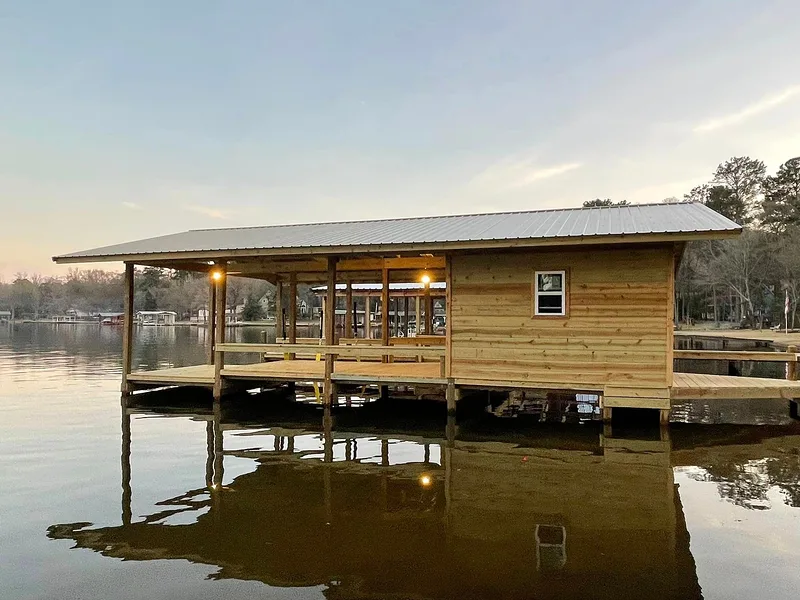
A cedar-clad boathouse built by Shoretech on Houston County Lake — one of several standing over this water.
Shoretech replaced the aging 1980s marina at Crockett Family Resort with a new small-slip layout, sequencing the demolition, pilings and decking so the resort kept usable water through the job. The boathouses came before and after it — covered slips, enclosed storage rooms, side walkways — and a family swim pier sits just down the road in Lovelady.
Every photograph on this page is Shoretech's own completed work on Houston County Lake. On a lake this size, that record is checkable: ask around at the ramp.
Numbers first: 267, 262, 260, 50, 12.
Houston County WCID No. 1 — office on County Road 2125 outside Crockett, 936-544-3985 — publishes rules specific enough to design from.
A District permit is required before constructing or modifying any bulkhead, pier, dock, boathouse, boat ramp, marina, wharf or pumping station below the 267-foot contour. The application states the location and size of the work, includes a construction plan, carries a nonrefundable $250 permit-and-inspection fee and a release of liability for water damage — and the permit number must be prominently displayed on the finished structure. Nothing habitable may sit below the 269-foot contour.
The build envelope is equally concrete. A permitted structure may extend no more than 50 feet lakeward from the shoreline at the 262-foot contour and stand no more than 12 feet tall measured from that elevation. In coves, structures are allowed only where the inlet is at least 60 feet across at its entrance, with 30 feet kept clear between structures and nothing reaching more than one-third of the way across. Bulkheads have their own rules: no new wall below the 260-foot contour, replacements set in the same location with the old wall removed, and no bulkhead may fill in the lake. Even stump clearing is written down — only in front of your own property, up to 30 feet lakeward of the boathouse.
Shoretech drafts to the District's envelope, files the application, and hangs the permit number where the rules say it goes.
Covered slips on near-constant water.
Two more of Shoretech's Houston County Lake boathouses — a double-slip with its walkway at dusk, and a gable-roof build mirrored in still water.


Crockett FAQ.
Do I need a permit to build a dock or boathouse on Houston County Lake?
Yes. Houston County Water Control and Improvement District No. 1 owns the water rights and operates the dam, and a District permit is required before constructing or modifying any structure below the 267-foot contour. The application states the location and size of the work and includes a construction plan, a nonrefundable $250 permit-and-inspection fee, and a release of liability for water damage — and the permit number has to be prominently displayed on the finished structure. The District office is on County Road 2125 outside Crockett, 936-544-3985. Shoretech carries that paperwork as part of the job.
How far out into the lake can a structure reach?
Fifty feet lakeward of the shoreline at the 262-foot contour, no taller than 12 feet measured from that same elevation, with red reflectors at least three inches across spaced no more than 15 feet apart on every lake-facing side. Coves tighten further: an inlet must be at least 60 feet across at its entrance, 30 feet stays clear between structures for boat traffic, and nothing may extend more than one-third of the way across or 50 feet, whichever is less.
What has Shoretech actually built on Houston County Lake?
The marina at Crockett Family Resort, rebuilt — the aging 1980s structure replaced with a new small-slip layout while the resort kept usable water through the job — along with boathouses over this lake and a family swim pier just down the road in Lovelady. The photographs on this page are Shoretech's own completed Houston County Lake work.
What decides the cost of a bulkhead or boathouse here?
The wall's height, the soil behind it, equipment access to the bank, the material — galvanized steel, vinyl, FRP composite or heavy timber — water depth at the toe, and the District's permitting requirements, which are specific: a new bulkhead may not be placed below the 260-foot contour, a replacement wall goes in the same location with the old one removed, and no bulkhead may fill in the lake. There is no honest number without a site visit — tell Dave what is standing on your bank now.
Is Houston County Lake steady enough for a fixed pier?
It is close to ideal. The conservation pool sits at 260 feet above mean sea level and the lake typically moves only one to two feet a year, so fixed piers, full-height bulkheads and boathouses can be built tight to the waterline without designing around a seasonal drawdown. The water is clear to slightly stained and about 40 feet deep at maximum, and the District still requires every fixed structure to be anchored to withstand anticipated wave and weather conditions.
The lake page, the home water, and the services.
Planning waterfront work out FM 229?
Tell Dave which part of the lake you are on, what is standing at the waterline now, and what you want the finished frontage to do. The District application, the design and the build get handled as one project — the way the marina was.