Call Dave: 936-662-5100
Waterwood · San Jacinto County

Boathouses, bulkheads and piers in Waterwood.

An 8,000-acre resort community building on Lake Livingston's northwestern shore since 1972 — much of Waterwood's waterfront is now on its second or third owner and its first structure. That is most of the work here.

The Community

A 1972 development with a fifty-year-old waterfront.

Off US 190 in northern San Jacinto County, about 27 miles northeast of Huntsville — carrying Huntsville addresses.

Waterwood is one of Lake Livingston's biggest planned communities: roughly 2,100 single-family lots, about 1,350 of them individually owned, with around 400 homes, townhouses and cottages built since development began in 1972 — the Waterwood Improvement Association's own accounting. The WIA governs the community; water and sewer come from Waterwood Municipal Utility District No. 1, a separate taxing district. The anchor amenity is Waterwood National, the 18-hole course opened in October 1974, with access arrangements that have changed over the years.

On the water, the community has boat-ramp and fishing-pier access, and Texas Parks & Wildlife lists the Waterwood entrance — US 190 to FM 980 — as a named access point. The waterline itself is not community ground: TRA holds fee ownership of the lakebed up to the 131-foot normal pool, so every structure at the water stands on TRA property and is authorized before it is built.

Together those facts define Waterwood's construction market: a large stock of aging waterfront structures, on a shore where replacing one is a permitted, sequenced project rather than a weekend of carpentry.

What Shoretech Builds Here

Replacement first, additions second.

Fifty years of docks and boathouses come due on their own schedule.

Boathouse Replacement & New Builds

New boathouses inside the general permit's envelope — 2,500 square feet gross plan view, 150 feet maximum reach — and honest tear-outs of the ones past saving, removed before the new structure goes in, as the permit requires.

Bulkheads for an Open Shore

Galvanized steel, vinyl, FRP composite and heavy timber walls sized to a shore where the main basin runs up to nine miles wide and wind-driven chop works the same waterline all year.

Piers, Docks & Swim Decks

Fixed structures built tight to a pool that moves only a foot or two a year, with pilings jetted or driven — the only methods the permit allows.

Slip & Access Dredging

Dredging runs separately under Nationwide Permit 19 with TRA's own dredging application — paperwork Shoretech handles, since prop-washing a slip clear is prohibited.

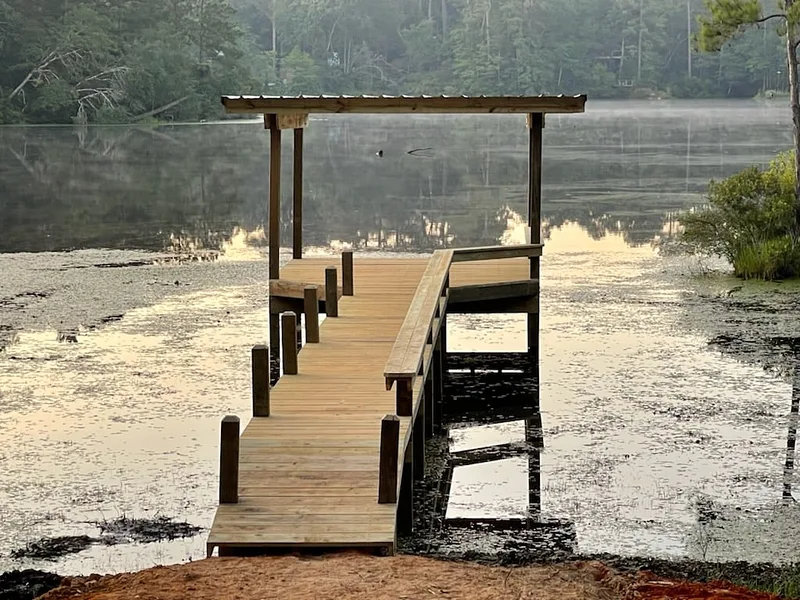
Covered pier with bench railings built by Shoretech on Lake Livingston, extending over still water at dawn
Permits Before Pilings

TRA's water, the Corps' permit, one application.

A covered pier built by Shoretech on Lake Livingston — the same water and permit regime Waterwood sits on.

Shoreline structures here are authorized under U.S. Army Corps of Engineers General Permit SWG-2007-00720, administered locally by TRA as the Corps' designee. The application is a real package — a plan-view drawing with dimensions, a cross-section showing deck height above pool and water depth at the terminal structure, the lot's waterfront width, any mapped wetlands within 50 feet — filed through the Lake Livingston Project's online portal. The current permit runs through December 31, 2028.

Shoretech prepares and carries that package as part of the project, and designs to its conditions from the first sketch.

131 ft
Normal pool msl — TRA owns the lakebed to this line
2,500
Max structure size in sq ft, gross plan view, overhangs included
150 ft
Maximum reach into the lake, or one-third of a cove's width
2028
Current general permit runs through December 31
Questions We Hear

Waterwood FAQ.

Who approves a boathouse or bulkhead on a Waterwood lot?

The Trinity River Authority. TRA owns the bed of Lake Livingston up to the 131-foot normal pool elevation, so a bulkhead, boathouse or pier at the waterline stands on TRA property and needs its authorization before work starts. Applications go through the Lake Livingston Project's online portal, and the permits office answers at 936-365-2292. The Waterwood Improvement Association governs the land side of the lot; check its rules alongside the TRA application.

How big can a boathouse be here?

The general permit caps a structure at 2,500 square feet in gross plan view — counting roof overhangs, walkways, lifts and every appurtenance, not just the slips. It can extend no more than 150 feet out into the lake, or one-third of the width of a cove or creek, whichever governs. No living quarters, no covered second story, and enclosed storage is limited to 200 square feet.

Our structure dates to Waterwood's early years. Repair or replace?

That gets answered at the pilings, not over the phone. Some structures need only decking, hardware and a straightened lift; when the framing below the waterline has gone soft, replacement is the honest call — and under the general permit a replacement structure cannot go in until the unserviceable one it replaces has been removed.

What drives the cost of a new bulkhead in Waterwood?

Wall height, the soil behind it, equipment access down the lot, material — galvanized steel, vinyl, FRP composite or heavy timber — water depth at the toe, and the TRA-permitted design the wall has to satisfy. Exposure matters too: the main basin runs up to nine miles wide, and a wall facing open water is engineered differently from one tucked into a cove. A site visit answers it properly — tell Dave what is standing on the bank now.

Does Lake Livingston get drawn down in winter?

No. It is a constant-level water-supply reservoir, held near the 131-foot pool with only one to two feet of annual fluctuation. There is no seasonal drawdown to build around, which rewards fixed piers and full-height bulkheads set tight to the waterline. The flip side: the same waterline takes wave action at the same elevation year-round, which is exactly how an unprotected bank erodes.

Start With What Is Standing There

Waterwood waterfront due for its second structure?

Tell Dave what year it went in, what the pilings look like, and whether the lot faces open water or a cove. The assessment, the TRA application and the design are handled as one job.