A string line down the cap
Note where the wall departs from the line, and by how much. That one measurement separates a lean from a bow.

Eight things owners find on a shoreline walk, what each is telling you about the wall, and a plain verdict on whether it can wait. One or two are genuinely minor, and we say so.
Photograph anything odd, note the date, mark where you stood. What a contractor reads is change over time.
Almost everything written about seawall failure was written for the coast, and usually ends by selling one proprietary fix. A wall on a Texas lake fails for its own reasons: groundwater pressure in the backfill after rain, soil migrating out through the wall, and anchors corroded or never long enough.
Each sign carries a verdict. Watch it means look again next season. Get it looked at means repairable now, worse and dearer if left. Call now means the wall is losing something it cannot get back.
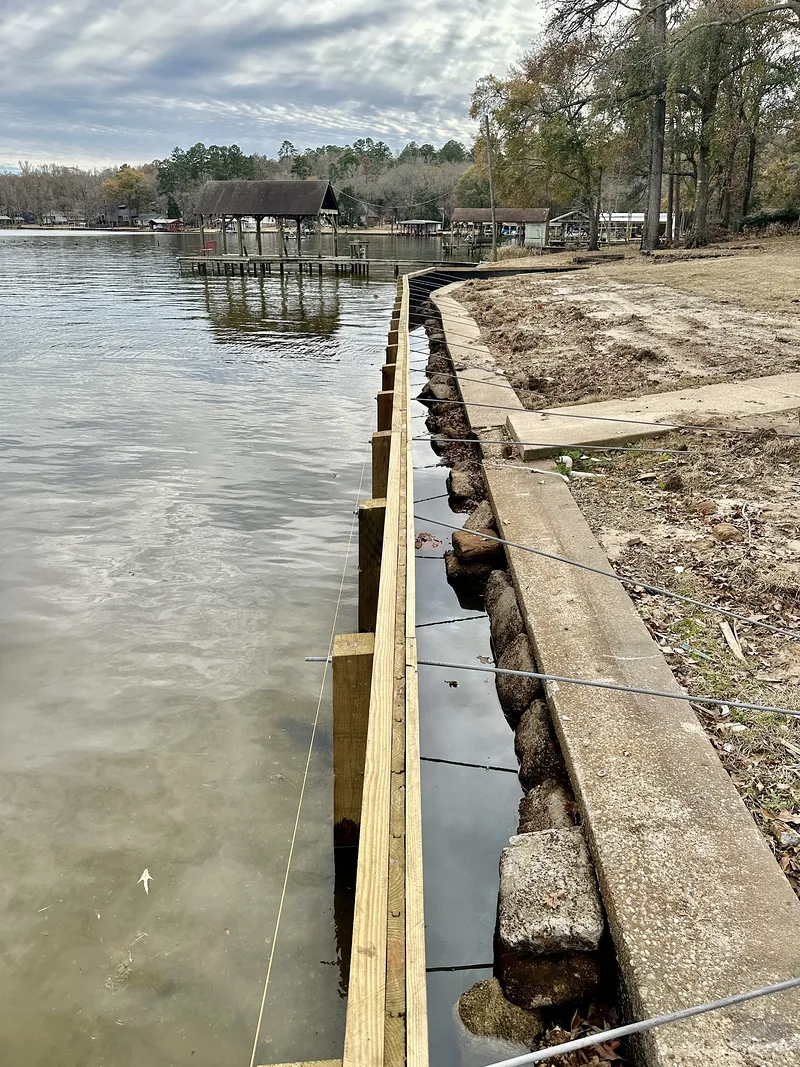
There is the face you can see, and the anchor system behind it — tie rods running back to deadmen buried in your yard.
The two age on separate schedules, and the buried half usually goes first. That is why a wall can look respectable from a boat and be nearer failure than an ugly one holding its line.
Sight down the cap end to end — most of these show up in that first look.
Base still where it belongs, top rotated toward the water. That is the anchor system letting go — rods corroded through, deadmen rotted or pulled through soft backfill. There is no universal number of inches that means trouble, so measure at several points rather than judge by eye. Verdict: get it looked at now. Re-anchoring works today; left alone it goes all at once. See why a bulkhead leans.
A worse diagnosis than a lean. The wall is rotating rather than tilting: it has lost the soil in front of the toe that holds the bottom. Anchors cannot fix a foundation problem, so this usually means replacing that run with toe protection. Verdict: call now, and keep vehicles and stored weight off that stretch.
Your backfill is leaving through the wall, and the ground is arching over the space it left — so the hole you see is a fraction of what has gone. It is also the soil your deadmen were relying on. Verdict: call now — and stake it off, because it is a safety hazard too.
This is the escape route itself, not a separate problem. Confined to a few joints it is maintenance: re-fabric behind them, re-fasten, restore backfill. Joints opening uniformly across many bays mean the anchor line has gone slack, and closing them without re-anchoring buys nothing. Verdict: get it looked at.
The cap is a strain gauge for everything underneath, and the answer here is often reassuring: a split, rotted or loose cap board with the wall still in line is a minor repair. A cap that has moved off the line is reporting displacement below it. Verdict: watch it if only the board is damaged; call now if it has stepped out of line.
Steel you cannot see is consuming itself — through-bolts, whaler hardware, and the tie rods where they pass through the face. A stain at one bolt is a local fastener replacement. Stains repeating at regular spacing along the tie-rod line mean the whole anchor system is corroding on one schedule. Verdict: get it looked at — the only sign that reliably appears before movement.
Pressure is winning between two anchor points: that bay's deadman has failed while its neighbours hold, or drainage stopped and the wall is holding water after rain. A bow localizes the failure to one anchor; a lean generalizes it to the whole line. Verdict: get it looked at — or call now if the bow is growing or the boards have split.
The least visible sign, and one of the most useful. A run that has gone the same way twice is telling you the diagnosis was wrong or the cause was never addressed. Verdict: call now, and ask for the cause to be named before scope is priced — the whole of repair or replace.
Half an hour with what is in the garage turns a conversation about how the wall looks into one about how far it has moved.
Note where the wall departs from the line, and by how much. That one measurement separates a lean from a bow.
Plumb the face at several points. Where it is out, note whether the top or the bottom leads — that direction is the diagnosis.
Probe boards, wale and posts where the wall is alternately wet and dry. Sound timber pushes back; punky wood takes the blade to the hilt.
Mark the stations so the next reading comes from the same place. One reading describes a wall; two say whether it is still moving.

A lake wall fails after the events that load it — so walk it twice a year, and again after these.
After a heavy rain. The most useful time to look: water in the backfill with nowhere to go is what pushes a wall, and it is when the escape routes show themselves.
When the lake is low. Low water exposes the toe and the bottom of the boards. Photograph it then — there will not be another look until it drops again.
After work next door. New grading, a downspout run or a neighbour's wall can change where water arrives on your backfill — and a wall rebuilt without fixing that fails twice.
The full inspection routine is in Built to Last.
Based in Trinity — more than 40 years, 250-plus boathouses, 850-plus projects.
Rust staining at the hardware line usually shows first, because steel corrodes before anything visibly moves. After that come open joints between the boards and small soft spots in the lawn behind the wall. All three are cheap to act on and easy to walk past.
A sinkhole behind the wall, a toe that has kicked out, or a stretch that has moved again after an earlier repair are the ones to call about now. A rotted cap board with the wall still in line can genuinely wait.
Because it is leaving through the wall. Water escaping at an open joint or under the toe carries the fines with it, and the coarser soil arches over the space left behind — which is why the depression is smaller than the void beneath it.
It depends whether the cap is damaged or displaced. A split or rotted cap board with the wall still in line is a minor repair. A cap that has stepped out of line is reporting movement below it, and replacing it would replace the evidence.
Twice a year, plus after heavy rain and whenever the lake is low enough to expose the bottom of the wall. Rain is when the escape routes are visible; low water is your only look at the toe.
Most of the looking, yes. A string line down the cap, a level on the face and a screwdriver in the waterline band will tell you whether the wall has moved and whether the timber is sound. What you cannot see is the anchor system, and that decides most jobs.
Send photographs down the length of the cap and of anything odd in the yard behind it, dated. Then have Dave walk it.