
Leaning Bulkhead · Texas & Western Louisiana Lakes
A leaning bulkhead is telling you which half of it failed.
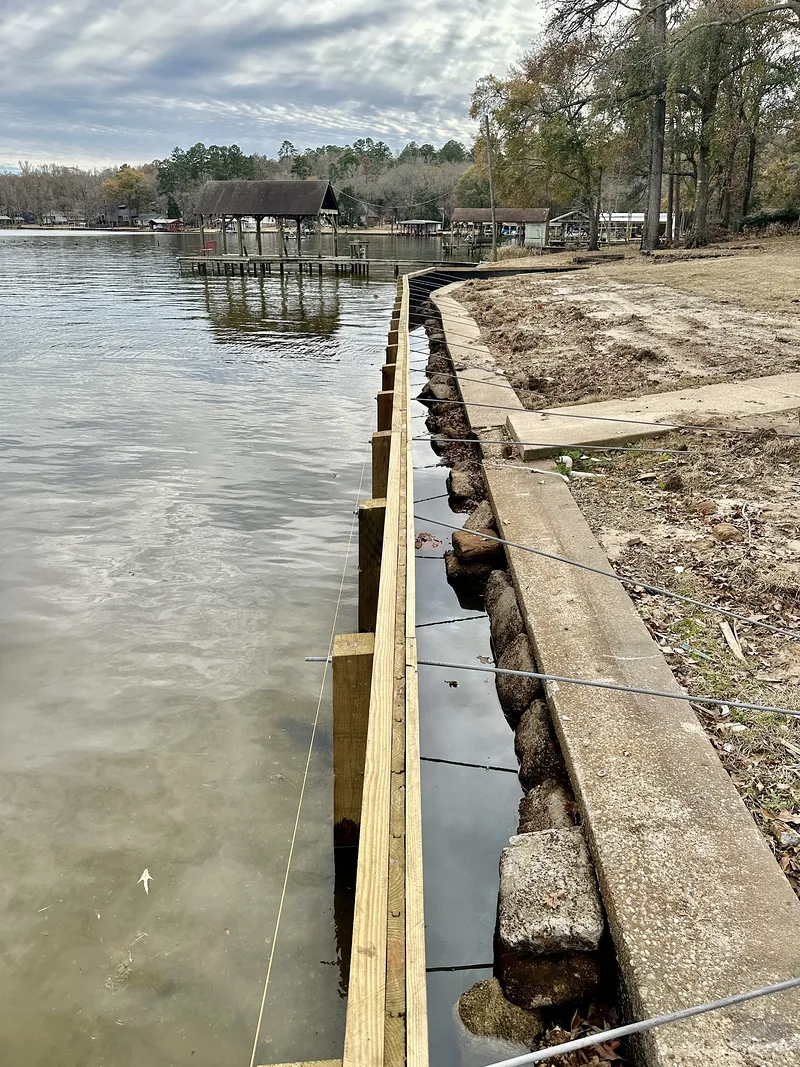
Top tipped toward the water with the base still in place is one problem. The base walked out while the top stayed plumb is a different and worse one. A single bay bellied while the rest holds its line is a third. Read the direction and you are most of the way to the diagnosis.
Start Here
Nothing about your wall is tidal.
Search why a seawall leans and you get Florida: tidal drawdown, storm surge, weep holes, and a pitch for foam injection into coastal sand.
Almost none of that describes a wall on a Texas reservoir. There is no twice-daily tide here pulling the water down and leaving your backfill loaded with nothing to push against. The pool is held behind a dam at an elevation somebody manages, and when it drops it drops on a schedule set by rainfall, water supply and flood operations rather than the moon. The ground behind your wall does not know any of that. It gets wet when it rains, it stays wet, and it pushes.
So the failure has the same shape and a different cause, which matters because the cause is what you are buying a fix for. Out here a lean almost always comes back to the buried half of the wall: what ties it back to your yard, whether water can get out of the ground behind it, and whether the bottom still has anything to stand on.
This page is the long read on one symptom. If you are working through several at once, the full list is on the warning signs page, and the assessment we run on a failing wall is set out under bulkhead and seawall repair.
Why a Wall Leans at All
Half your bulkhead is buried in your own lawn.
The boards or sheets you can see hold the soil back. Something you cannot see stops the top of them rotating toward the lake.
That second structure is the anchor system: rods running inland from the face to anchors buried well behind it, tied together along the wall by a wale. It is what turns a row of planks into a retaining wall. The face can be in fine condition and the wall will still tip out if the anchors have corroded through, if the anchors themselves have rotted or been pulled through ground gone soft, or if the wale has split and stopped spreading load along the run.
Which is why a lean is rarely a verdict on the wood you are looking at. It is a report on hardware buried under your grass — and the reason nobody can price this from a photograph.
Read the Lean by Direction
Four patterns, and what each one costs you.
Sight down the cap from one end, then look at the toe from the water side at low pool. The shape of the movement is the diagnosis.
1
Tipping out at the top, base still where it belongs
The most common pattern we are called about, and the most hopeful one. The anchor line has stopped holding and the wall is now leaning on its embedment alone, like a fence post with the top pushed. Rods lose section where they pass through the wall, anchors rot or drag through saturated ground, and a split wale hands its load to its neighbours until they go too. If the face is still sound, this is anchor work, not a new wall.
2
Toe kicked out at the bottom, top roughly plumb
The wall is rotating rather than tipping, and this one is serious. It means the material that held the bottom in place is gone — commonly scoured out by wake and prop wash at a pool that sits at the same elevation for months, or carried out from underneath along with your backfill. The wall is no longer founded, and an anchor cannot fix a foundation. Keep vehicles, stored material and gatherings off the top of a wall doing this.
3
One bay bellied out, the ends still in line
A bow localises the failure. Between two anchors that are still working, one has let go — or that stretch has lost its drainage and is holding a column of water after every rain that the rest of the run is not. Good news, in a sense: one thing, in one place. Sound, unsplit wood in a bowed bay usually comes back. Wood that is bowed and split has already yielded.
4
The whole run leaning together, cap still straight
Nothing is uniform by accident. A wall that has gone over evenly along its length was built with a consistent anchor system — same rod, same spacing, same depth — and that system is reaching the end of its usefulness on the same schedule everywhere. Expect the honest answer here to be about the whole run, and expect a repair on one part of it to move the problem rather than solve it.
What Is Actually Pushing
Five loads that put freshwater walls over.
Rain with nowhere to go. Saturated soil weighs more than dry soil, and water trapped in the backfill adds its own pressure on top of that. If drainage was never built in, or has silted up over the years, every wet spell is a load test.
The lake dropping. Water standing against the outside of a wall is helping to hold it up. When the pool falls, that support goes and the saturated ground behind stays fully loaded for as long as it takes to drain. A drawdown is a load case in its own right, not just the calm after the flood.
Soil leaving through the joints. Open board joints and dead filter fabric let fine material wash out with the water. What you lose is not just lawn — it is the ground the anchors were counting on. A sinkhole behind the wall and a lean at the top are often the same failure told twice.
Steel and timber in the anchor line. Fresh water is kinder than salt, but the band that is wet and dry all season still eats unprotected hardware, and buried timber anchors rot out of sight. Rust staining along the face at regular spacing is the anchor line telling you what it is doing.
Scour at the toe. Wake and prop wash work on the bottom in front of the wall at whatever elevation the lake is holding. Take enough material out of there and the wall loses the passive support at its base — which is what turns a tip into a rotation.

How Far Is Too Far
Measure it yourself, then the conversation is about a number.
Lean is the one thing an owner can measure without any equipment, and it is worth doing before you call anyone — including us.
1
Set a reference you can find again
Two stakes at the ends of the run and a string line along the face at cap height. Mark stations along the wall with something that will still be there next season. The point is not precision. The point is repeatability.
2
Record the offset at each station
Hold a level plumb against the face and note how far out of vertical the top sits at each mark. Write the readings down with the date and the lake level, and photograph the run from the same standing spots.
3
Do it again after the next wet spell
This is the whole exercise. A single set of readings describes a wall; two sets separated by a season say whether it is stable or still going. No amount of looking at the wall substitutes for it.
4
Know why we will not give you a threshold
There is no inch-count that separates a fine wall from a failing one, and anyone offering one over the phone has skipped the diagnosis. What decides it is the rate of change, the direction of movement, whether joints have opened and soil is leaving, what the wood or steel has left in it, and what sits on top of the wall — a lawn, a deck, a driveway, a pool.
The Fix That Does Not Fix It
Foam fills a hole. It does not re-anchor a wall.
Injection is the answer the coastal market sells, and it is worth understanding exactly what it does before you buy it for a lean.
Pumped into voids behind a wall, foam fills them. If soil has washed out and left space, that is a real problem and filling it is a real thing to do. What foam cannot do is put tension back into an anchor system that has corroded through or pulled loose, because it is not an anchor — and on a leaning wall the anchor system is usually the part that failed. Fill the space behind a wall that is no longer tied back and you have a filled space and an untied wall.
The work that actually addresses a lean runs in the other order: find out what let go, restore the anchor line behind the failure plane, give the water somewhere to go, put back what has washed out, and protect the toe if that is where it started. How those pieces get built is on the bulkheads and retaining walls page, and the routine that catches the next one early is in Built to Last.
Where We See This
The same lean, on the same water, for forty years.
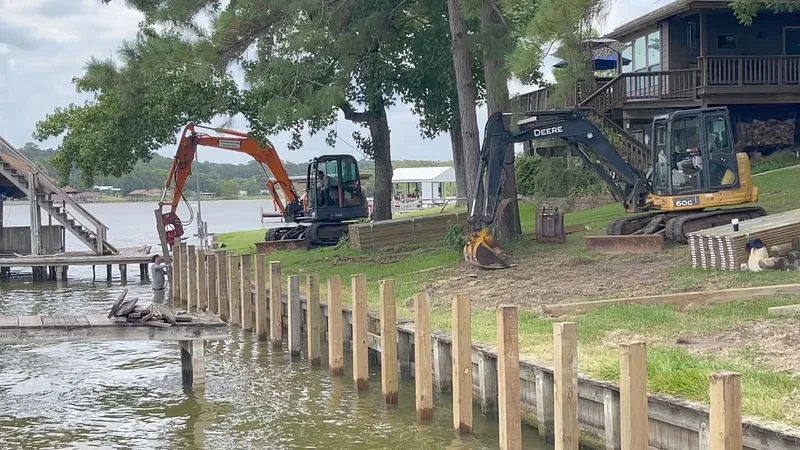
Based in Trinity, building waterfronts for more than 40 years — over 250 boathouses and 850-plus projects.
Service area
- Texas and western Louisiana waterfronts
- Private ponds and small lakes
- Subdivision, association and commercial shoreline
- Dave travels as far as the work requires
Authorization, not completed work. Lake Lewisville is not on the list above, but one authorization there is worth naming, because it is about failed walls specifically: on Lake Lewisville the U.S. Army Corps of Engineers had stopped permitting shoreline reinforcement after years of walls failed. Shoretech is currently the only contractor they permit to build steel or heavy timber bulkheads there, and that authorization runs through the end of December 2027. It does not make permitting automatic — your own shoreline still has to qualify.
Questions We Hear
Leaning bulkhead FAQ.
What makes a bulkhead lean on a lake with no tide?
Water in the ground behind it, mostly. Rain soaks the backfill, the backfill cannot drain, and the pressure it puts on the wall goes up until something in the anchor line gives. Add soil quietly leaving through open joints, rods and hardware losing section in the wet-and-dry band, and a lake that drops on its own schedule and unloads the water side while the saturated side stays loaded, and you have the four things we find behind most leans out here. None of them needs a tide.
Does it matter whether the top is tipping out or the bottom is kicking out?
It is the single most useful thing you can tell us on the phone. A wall tipped out at the top with its base where it belongs has an anchor problem, and anchors can be restored. A wall whose toe has walked out while the top stayed roughly plumb has lost the ground holding its bottom, and no anchor fixes a foundation. Two walls that look equally alarming from the house can be a repair and a rebuild.
How do I measure the lean so the number means something?
Run a string line along the face at cap height between two stakes you can leave in place. At marked points along the run, hold a level plumb against the wall and record the offset at each one, then date the sheet and take photographs from the same spots. Do it again after the next wet spell. One set of readings describes a wall. Two sets tell you whether it is moving, and that is the number that changes what should be done.
How far can a wall lean before it becomes an emergency?
There is no honest inch-count, and a contractor who gives you one before measuring is selling, not diagnosing. What decides urgency is the rate the lean is changing, the direction it is moving, whether joints have opened and soil is actively leaving, and what is sitting on top of the wall. A wall that has been slightly out of plumb for years and has not moved since is a different situation from one that moved this month.
Why did my bulkhead move right after a week of heavy rain?
Because rain is the load. Saturated backfill is heavier than dry backfill, and once the ground behind the wall holds water that cannot get out, the wall has to carry that water pressure as well as the soil. If the anchors were already marginal, a long wet spell is when they finish. That is also why a downspout, a neighbour's grading or a driveway shedding toward the wall can be the real cause of a lean.
Will foam injection straighten a leaning bulkhead?
Injected foam fills voids. That is a real thing to want if soil has gone missing behind your wall, and it is why the coastal pages sell it. What it does not do is put tension back into a broken anchor system, and on a leaning wall the anchor system is usually the thing that failed. Filling the space behind a wall that is no longer tied back leaves you with a filled space and an untied wall.
Read Next
Where this goes from here.
Before the Next Wet Spell
Bring your measurements. Dave will find the anchors.
Photographs down the length of the cap, a note of which way it is going, and two sets of readings if you have them. What settles it is an hour on the bank finding what your wall is tied back to and probing what is left behind it.